CE3501 Environmental Engineering Fundamentals
Examination on Environmental
Biology
Name: SOLUTION
Problems (60 points)
1. Population growth (15
points)
A population of microorganisms has a maximum specific growth rate coefficient equal to 0.5 d-1 and a respiration rate coefficient of 0.2 d-1. The population is growing exponentially, i.e. in the presence of excess substrate and well below its carrying capacity.
a. Write the differential equation describing a mass balance on this population in a batch reactor (i.e. no inflow or outflow).
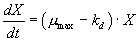
b. Calculate the population size after 10 days if the initial population is 10 cells·mL-1.
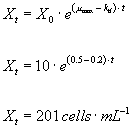
2. Population Growth (15 points)
One approach to the remediation of subsurface soil and water contamination is to introduce microorganisms with the capacity to biodegrade the pollutant. A target or minimum pollutant concentration is set and organisms are selected which will lower the contamination to that level. The organism best suited for the job is the one which grows fastest at the target contaminant level. The table below identifies the target concentration and describes kinetic coefficients for two candidate microorganisms.
|
Organism |
Maximum specific growth rate (d-1) |
Half saturation constant (mg·L-1) |
|
“A” |
2.0 |
20 |
|
“B” |
0.5 |
2 |
|
Target concentration = 0.1 mg·L-1 |
||
a. Write the differential equation describing a mass balance on this population in a batch reactor (i.e. no inflow or outflow).
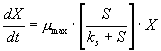
b. Determine the specific growth rate for each organism.


The target concentration was intended to be 0.1 mg·L-1 and was incorrectly specified as 0.1 mg·L-1. Either choice was accepted and the 0.1 mg·L-1 solution is presented here.
c. Based on Question 2, Part B, identify the best candidate for the job.
Organism B because it has the highest growth rate at the target concentration.
3. Oxygen Demand (20 points)
A vinegar manufacturer generates a waste stream containing essentially pure acetic acid, C2H4O2, at a concentration of 120 mg·L-1. The waste has a 5-day CBOD of 50 mg·L-1 and a CBOD reaction rate coefficient of 0.1 d-1.
a. Determine the theoretical oxygen demand of the waste.

b. Determine the ultimate carbonaceous oxygen demand of the waste.

c. Estimate the COD of the waste, defending your estimate.
Because COD represents a near total oxidation of the waste, the COD should be approximately the same as the ThOd.
d. Comment on the biodegradability of the waste.
The waste is highly biodegradable because the ultimate CBOD is approximately equal to the ThOD.
4. Oxygen in Rivers (10 points)
A river with a flow of 9 m3·s-1, a temperature of 20 °C, and saturated with respect to dissolved oxygen receives a 1 m3·s-1 waste discharge with a dissolved oxygen concentration of 2 mg·L-1. The partial pressure of oxygen is 0.21 atm and the Henry’s Law constant at 20 °C is 1.356x10⁻³ moles·L-1·atm-1.
a. Determine the dissolved oxygen concentration of the river upstream of the waste discharge.
The stream is saturated with respect to oxygen upstream of the discharge.
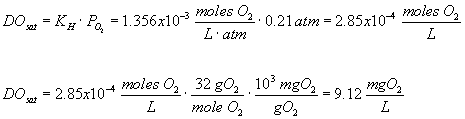
b. Determine the dissolved oxygen concentration of the river when it mixes with the waste discharge.

B. Concepts and Definitions
(40 points)
1. The organism group in which all members are pathogens. In class, we heard how a member of this group has been implicated in killing salmon in fish farms.
viruses_______________________________________
2. The three organism groups which include primary producers. In class we heard about stimulation of one of these groups by African dust clouds. Another group was involved in remediation of MTBE (gasoline additive) contamination. The third group included an invader which is choking canals and lakes with dense vegetation.
algae__________________ bacteria_______________ macrophytes____________
3. The three organism groups which act as grazers in the microbial loop. In class, two of these groups were discussed in relation to screening for toxic substances. The thirds group was implicated as a reservoir for Legionnaire’s disease.
rotifers_______________ microcrustaceans_______ protozoa_______________
4. The organism group which inhabits the bottom or benthos and is indicative of water quality in rivers. The example brought to class dealt with a recent Great Lakes ‘invader’.
macroinvertebrates____________________________
5. The consumption of oxygen as ammonia nitrogen is converted to nitrate nitrogen is termed the nitrogenous biochemical oxygen demand. In wastewater treatment plants, this demand is exerted in the aeration basin. In the biogeochemical nitrogen cycle this conversion process goes by a different name. What is it?
nitrification_________________________________
6. Nitrogen is the nutrient limiting algal growth in marine and estuarine environments and is removed at wastewater treatment plants discharging to coastal waters through the anaerobic conversion of nitrate to nitrogen gas. What is the name of this step in the biogeochemical nitrogen cycle?
denitrification_______________________________
7. In efficiency in energy transfer up the food chain was demonstrated in class through the example of “cows and potatoes”. Identify the two loss processes which lead to this inefficiency.
respiration___________________________________
decomposition________________________________
8. Describe the role of the microbial loop in ecosystem function.
recycle organic matter lost from higher up on the food chain___________
Explain why, in a closed ecosystem, the microbial loop cannot sustain life indefinitely.
energy is lost to respiration and must be re-supplied__________________
9. The magnitude of the CBOD reaction rate coefficient typically decreases as one moves from raw wastewater ® treated wastewater ® river water. Why is this?
over this continuum, less biodegradable material is available______
10. In class, we concluded that oxygen in a river passing over a falls could not become supersaturated as a result of the violent mixing. Why is this?
Henry’s Law suggests that turbulence cannot lead to supersaturation____
11. The species diversity/individual abundance of the macroinvertebrate community of a severely polluted stream is:
[lower/higher] [higher/lower] [higher/higher] [lower/lower]
than that of a clean stream. (Circle One).
12. The buildup of a chemical in an organism as a result of exposure to contaminated water and ingestion of contaminated food is termed:
bioaccumulation______________________________
13. Because of the complexities involved with sampling and detecting individual species of pathogens in water, environmental engineers typically test for the presence of microbes associated with fecal contamination, also referred to as:
indicator organisms___________________________
14. In a thermally-stratified lake, the cold, well-mixed lower layer is called the:
hypolimnion___________________________________
15. The nutrient most often limiting plant growth in freshwater systems is:
phosphorus____________________________________
16. Alternate terminal electron acceptors such as NO3-, Fe3+, and SO4= are utilized in which metabolic process?
anaerobic respiration_________________________