Elements: Book I Proposition 47 (I.47)
the Pythagorean Theorem
Ching-Kuang Shene (冼鏡光), Professor Emeritus
Department of Computer Science
Michigan Technological University
Houghton, MI 49931
USA
Created March 18, 2026

In Book I of Euclid's Elements,
Proposition 47, usually referred to as I.47, is the Pythagorean Theorem.
The proof in Elements is very interesting
and should be presented here
before discussing propossitions II.12 and II.13
(i.e., Prosopotion 12 and Proposition 13 in Book II).
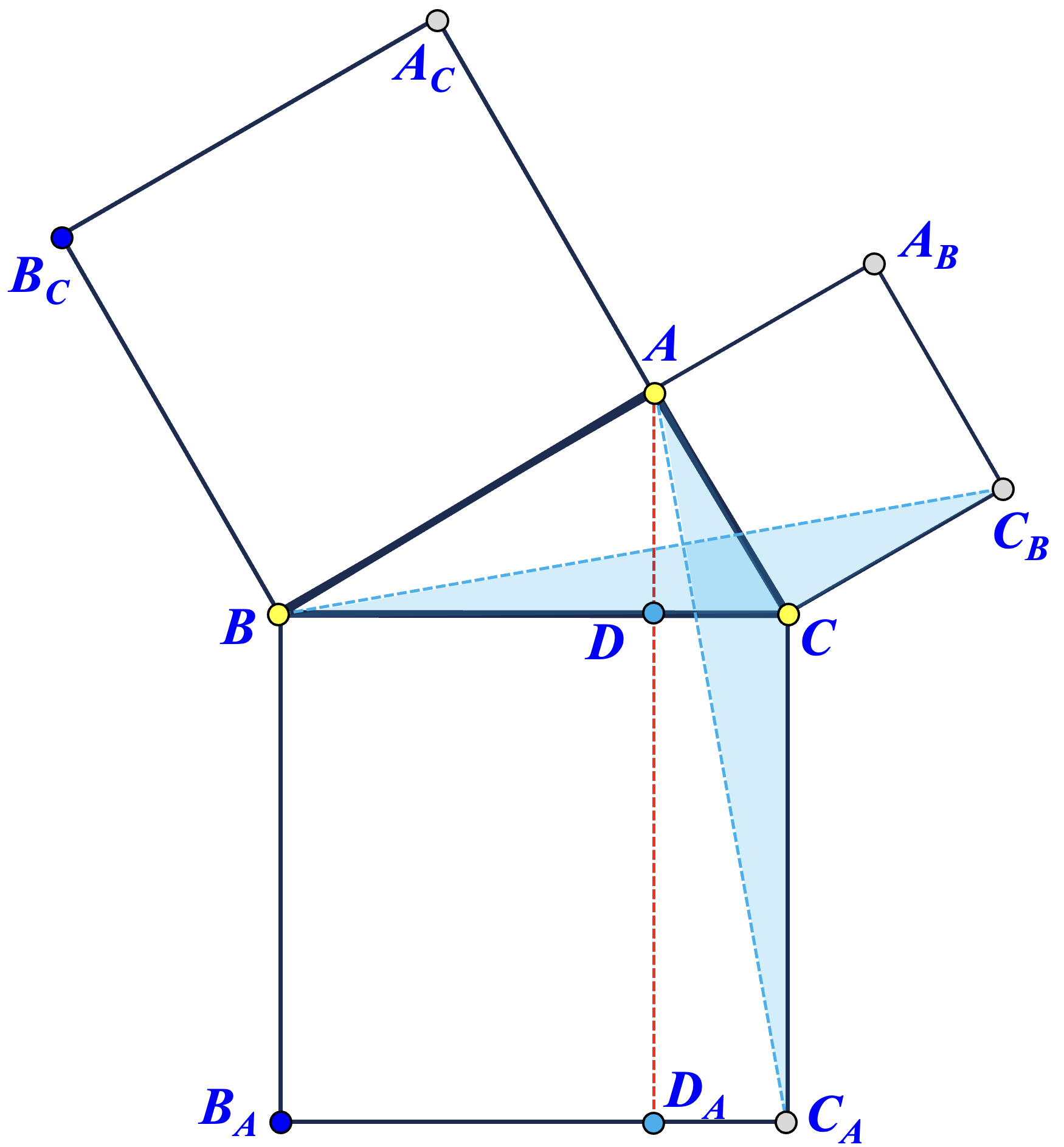
Given a right triangle \( \bigtriangleup ABC \) with \( \angle A = 90^{\circ} \),
let the squares on \( \overline{BC} \), \( \overline{CA} \) and \( \overline{AB} \)
be \( BCC_AB_A \), \( CAA_BC_B \) and \( ABB_CA_C \), respectively.
Drop a perpendicular from \( A \) to side \( \overleftrightarrow{BC} \)
meeting it at \( D \) and the oppsoite side of the square on \( \overline{BC} \)
at \( D_A \).
The line \( \overleftrightarrow{AD} \) divides the square on \( \overline{BC} \)
into two rectangles \( BDD_AB_A \) and \( CDD_AC_A \).
 The Scissors at \( B \)
|
 The Scissors at \( C \)
|
Consider the lines \( \overleftrightarrow{AB_A} \) and \( \overleftrightarrow{CB_C} \)
(the left diagram above).
We have two triangles, \( \bigtriangleup ABB_A \) and \( \bigtriangleup CBB_C \)
sharing a common vertex \( B \).
In fact, they are congruent, because
\( \overline{BC} = \overline{BB_A} \),
\( \overline{BA} = \overline{BB_C} \)
and
\( \angle ABB_A = \angle ABC + 90^{\circ} = \angle CBB_C \).
As a result, the areas of \( \bigtriangleup ABB_A \) and \( \bigtriangleup CBB_C \) are the same.
Furthermore, the area of \( \bigtriangleup ABB_A \) is half of the area of \( BDD_AB_A \),
because they share the same base \( \overline{BB_A} \) and the same altitude
\( \overline{BD} \).
Similarly, the area of \( \bigtriangleup CBB_C \) is half of the area of \( ABB_CA_C \).
Therefore, the areas of \( BDD_AB_A \) and \( ABB_CA_C \) are the same.
Do the same from vertex \( C \) (the right diagram above)
and the areas of \( CDD_AC_A \) and \( CAA_BC_B \) are equal.
Because the area of \( BCC_AB_A \) is the sum of areas of
\( BDD_AB_A \) and \( CDD_AC_A \),
we have that the area of \( BCC_AB_A \) is equal to the sum of areas
\( ABB_CA_C \) and \( CAA_BC_B \)
and this is what the Pythagorean Theorem says.
The triangles \( \bigtriangleup ABB_A \) and \( \bigtriangleup CBB_C \)
with the common veretex \( B \) is referred to as the
Euclid's Scissors at \( B \).
Similarly, triangles \( \bigtriangleup ACC_A\) and \( \bigtriangleup BCC_B \)
with the common veretex \( C \) is referred to as the
Euclid's Scissors at \( C \).
Note that in the right triangle case (i.e., \( \angle A = 90^{\circ} \),
there is no scissors at \( A \),
because they collapse to two segments.
However, if a triangle is not a right triangle,
then each vertex will have a pair of scissors at each vertex.
We will use the concept of scissors at each vertex
to prove propositions II.12 and II.13.
Go back to
Home Page.