The Law of Sines
Ching-Kuang Shene (冼鏡光), Professor Emeritus
Department of Computer Science
Michigan Technological University
Houghton, MI 49931
USA
Created March 16, 2026

Ching-Kuang Shene (冼鏡光), Professor Emeritus
Department of Computer Science
Michigan Technological University
Houghton, MI 49931
USA
Created March 16, 2026
For completeness, we prove that the Law of Sines is independent of the Pythagorean Theorem and the Pythagorean Identity, because this fact is mentioned multiple times at this site.
Given a triangle \( \bigtriangleup ABC \) with \( \angle A = \alpha, \angle B = \beta, \angle C = \gamma, \overline{BC}=a, \overline{CA}=b \) and \( \overline{AB}= c \), let the circumcircle of \( \bigtriangleup ABC \) be \( O \) and let its radius be \( R \).
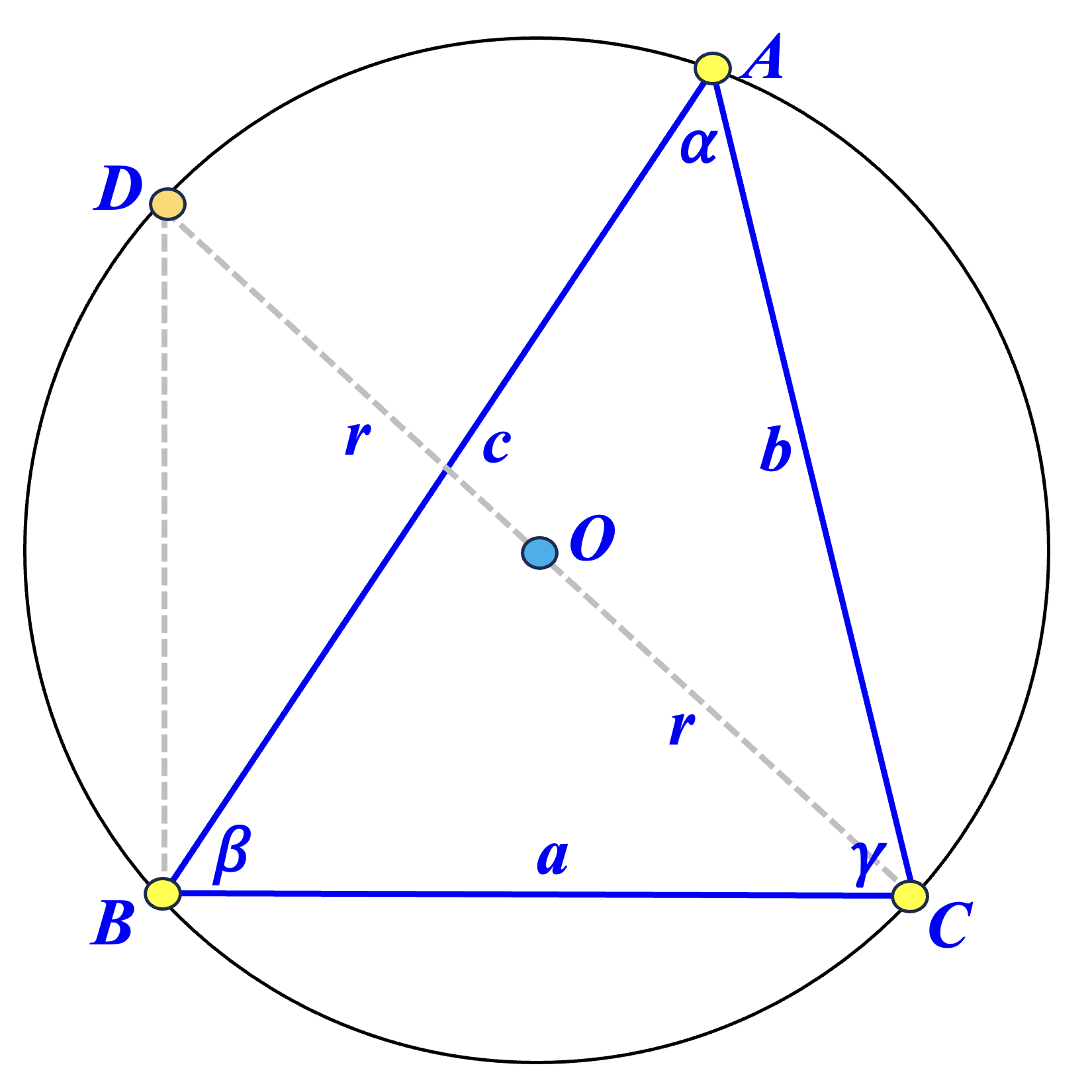
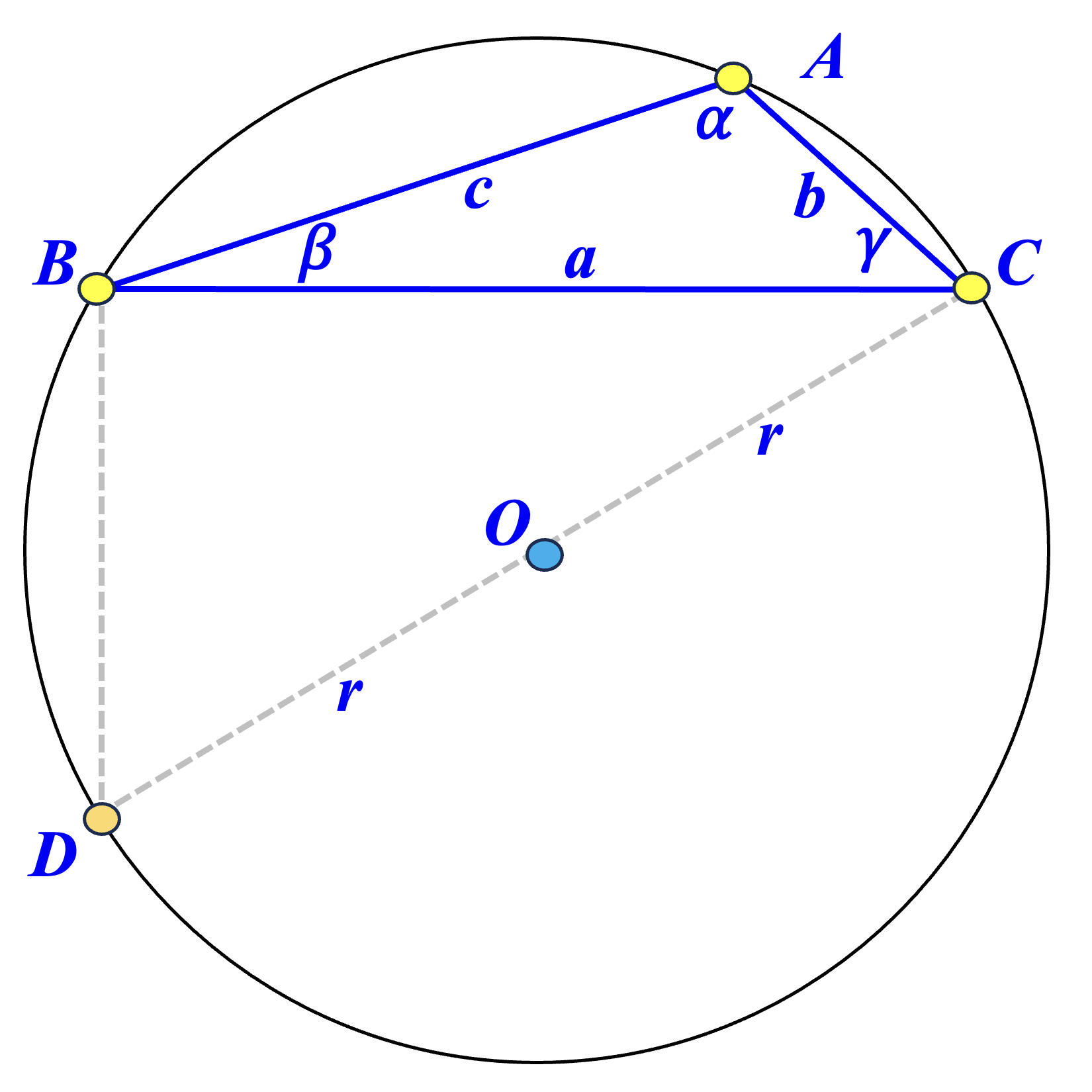
Let the line \( \overleftrightarrow{CO} \) meet the circle at \( D \). Then, \( \bigtriangleup BCD \) is a right triangle with \( \angle CBD = 90^{\circ} \), because \( \overleftrightarrow{CD} \) is a diameter. Consequently, \( \sin(\angle BDC)=\frac{a}{2R} \) holds.
If \( \angle A \) is acute (left diagram below), \( A \) and \( D \) are on the same side of \( \overleftrightarrow{BC} \) and \( \sin(\alpha)=\sin(\angle CDB) = \frac{a}{2R} \). As a result, we have the following: \[ \frac{a}{\sin(\alpha)} = \frac{a}{\sin(\angle CDB)} = \frac{a}{\left( \frac{a}{2R} \right)} = 2R. \] Note that \( 2R \) is a constant!
|
|
If \( \angle A \) is obtuse (right diagram above), \( A \) and \( D \) are on different sides of \( \overleftrightarrow{BC} \), and \( \sin(\alpha)=\sin(180^{\circ} - \angle CDB) = \sin(\angle CDB) = \frac{a}{2R} \). The following still holds: \[ \frac{a}{\sin(\alpha)} = \frac{a}{\sin(\angle CDB)} = \frac{a}{\left( \frac{a}{2R} \right)} = 2R. \] Therefore, we proved the Law of Sines without using the Pythagorean Theorem and the Pythagorean Identity: \[ \frac{a}{\sin(\alpha)} = \frac{b}{\sin(\beta)}= \frac{c}{\sin(\gamma)} = 2R. \]
Go back to Home Page.