Mollweide's Formulas
Ching-Kuang Shene (冼鏡光), Professor Emeritus
Department of Computer Science
Michigan Technological University
Houghton, MI 49931
USA
Created December 9, 2025
Modified February 25, 2026
Partially Rewritten March 16, 2026

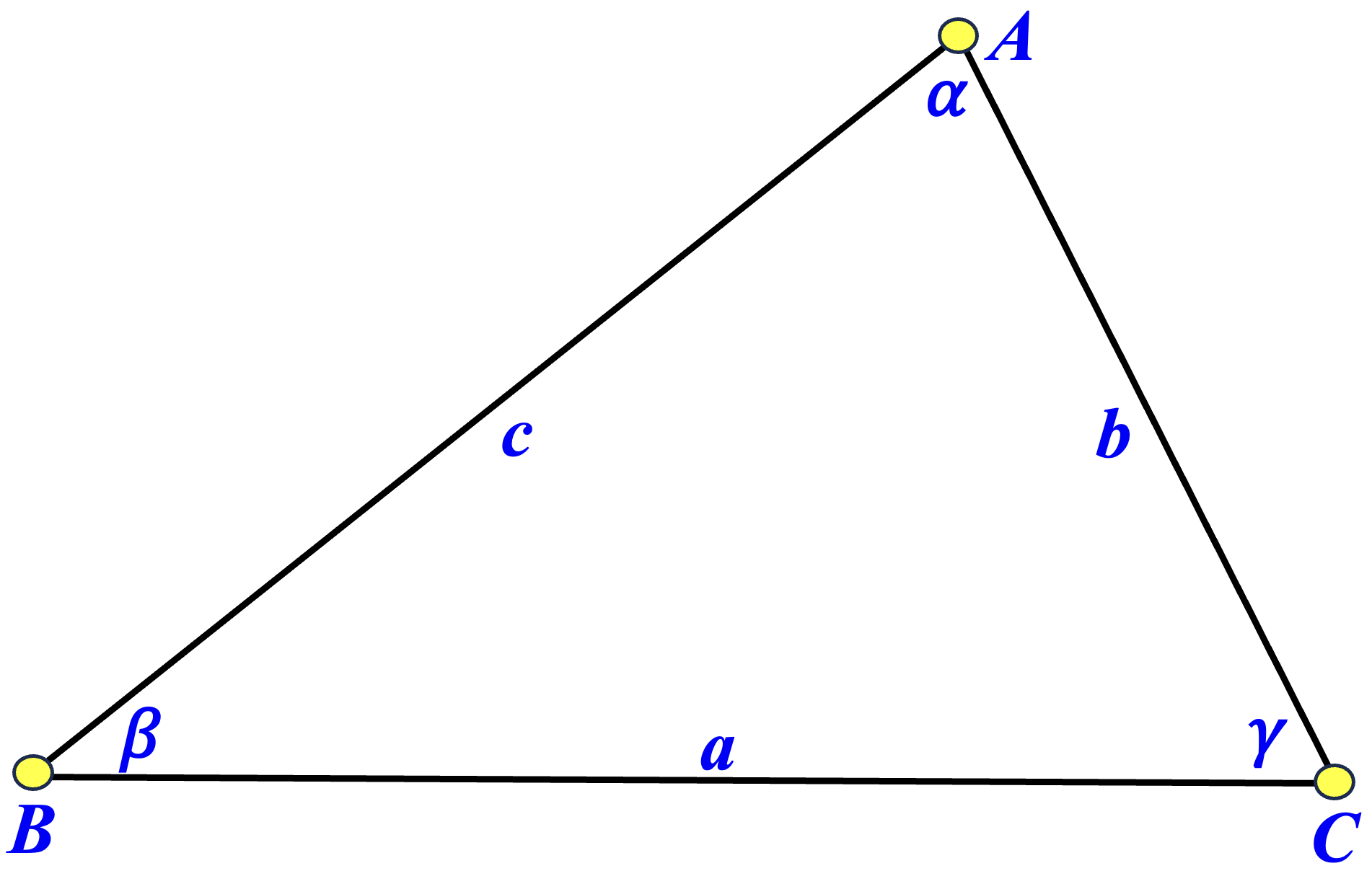
Given a triangle \( \bigtriangleup ABC \) with sides
\( a=\overline{BC}\), \( b=\overline{CA}\) and \( c=\overline{AC}\) and the angle opposite to
each side \( \alpha\), \( \beta\) and \( \gamma\) as shown below,
Mollweide's formulas are as follows:
\[ \frac{a-b}{c} =\frac{\sin\left( \frac{\alpha-\beta}{2}\right)}{\cos\left( \frac{\gamma}{2}\right)} \quad\mbox{and}\quad
\frac{a+b}{c} = \frac{\cos\left( \frac{\alpha-\beta}{2}\right)}{\sin\left( \frac{\gamma}{2}\right)}. \]
Mollweide's formulas relate the ides and angles of a triangle very
in a simple and interesting way.
Given the three side lengths \( a, b \) and \( c \),
there are six permutations: \(a-b-c, a-c-b, b-a-c, b-c-a, c-a-b \) and \(c-b-a\).
Each permutation has its corresponding formulas, and, hence, there are six pairs
of Mollweide's formulas.
For example, Mollweide's formulas corresponding to \( b-c-a \) are
\[ \frac{b-c}{a} =\frac{\sin\left( \frac{\beta-\gamma}{2}\right)}{\cos\left( \frac{\alpha}{2}\right)} \quad\mbox{and}\quad
\frac{a+b}{c} = \frac{\cos\left( \frac{\beta-\gamma}{2}\right)}{\sin\left( \frac{\alpha}{2}\right)}. \]
An Algebraic Proof
The following proof uses the Law of Sines,
which is simple and straightforward.
From the above diagram, the Law of Sines shows the following,
where the constant \( k \) is the length of the diameter of
the circumcircle of \( \bigtriangleup ABC \):
\[ \frac{a}{\sin(\alpha)} = \frac{b}{\sin(\beta)} = \frac{c}{\sin(\gamma)} = k \]
As a result, the sides are:
\[ a = k\sin(\alpha)\mbox{,\ \ \ \ \ } b = k\sin(\beta)\mbox{\ \ \ \ \ and\ \ \ \ \ }
c = k\sin(\gamma). \]
In this way, with the help of
the Sum-to-Product identities, we have
$$
\begin{eqnarray*}
a - b &=& k\left[ \sin(\alpha) - \sin(\beta) \right]
= 2k\left[ \sin\left(\frac{\alpha-\beta}{2}\right)\cos\left(\frac{\alpha+\beta}{2}\right)\right] \\
a + b &=& k\left[ \sin(\alpha) + \sin(\beta) \right]
= 2k\left[ \sin\left(\frac{\alpha+\beta}{2}\right)\cos\left(\frac{\alpha-\beta}{2}\right)\right]
\end{eqnarray*}
$$
Because \( \sin(\gamma) = 2\sin\left(\frac{\gamma}{2}\right)\cos\left(\frac{\gamma}{2}\right)\),
we have
\( c=k\csot\sin(\gamma)=2k\cdot\sin\left(\frac{\gamma}{2}\right)\cos\left(\frac{\gamma}{2}\right) \).
Hence, the following holds:
Applying the double angle identity to \( \sin(\gamma)\) gives
\[ \frac{a-b}{c}=
\frac{\sin\left(\frac{\alpha-\beta}{2}\right)\cos\left(\frac{\alpha+\beta}{2}\right)}{\sin\left( \frac{\gamma}{2}\right)\cos\left( \frac{\gamma}{2}\right)}
\quad\mbox{and}\quad
\frac{a+b}{c}
=\frac{\sin\left(\frac{\alpha+\beta}{2}\right)\cos\left(\frac{\alpha-\beta}{2}\right)}{\sin\left( \frac{\gamma}{2}\right)\cos\left( \frac{\gamma}{2}\right)}
\]
The terms with \( \frac{\alpha+\beta}{2}\) can be cancelled using
\( \frac{\gamma}{2}=\frac{180^{\circ}-(\alpha+\beta)}{2}
= 90^{\circ} - \frac{\alpha+\beta}{2}\),
\( \sin\left(\frac{\gamma}{2}\right) = \cos\left(\frac{\alpha+\beta}{2}\right)\)
and \( \cos\left(\frac{\gamma}{2}\right) = \sin\left(\frac{\alpha+\beta}{2}\right)\).
Consequently, we have Mollweide's formulas:
\[ \frac{a-b}{c}
= \frac{\sin\left(\frac{\alpha-\beta}{2}\right)}{\cos\left( \frac{\gamma}{2}\right)}
\quad\mbox{and}\quad
\frac{a+b}{c}
= \frac{\cos\left(\frac{\alpha-\beta}{2}\right)}{\sin\left( \frac{\gamma}{2}\right)}. \]
A Geometric Proof
This section provides a geometric proof using the Law of Sines.
Then, a proof without using the Law of Sines will be presented in the next section.
We have two cases to consider: \( a> b \) and \( a < b \).
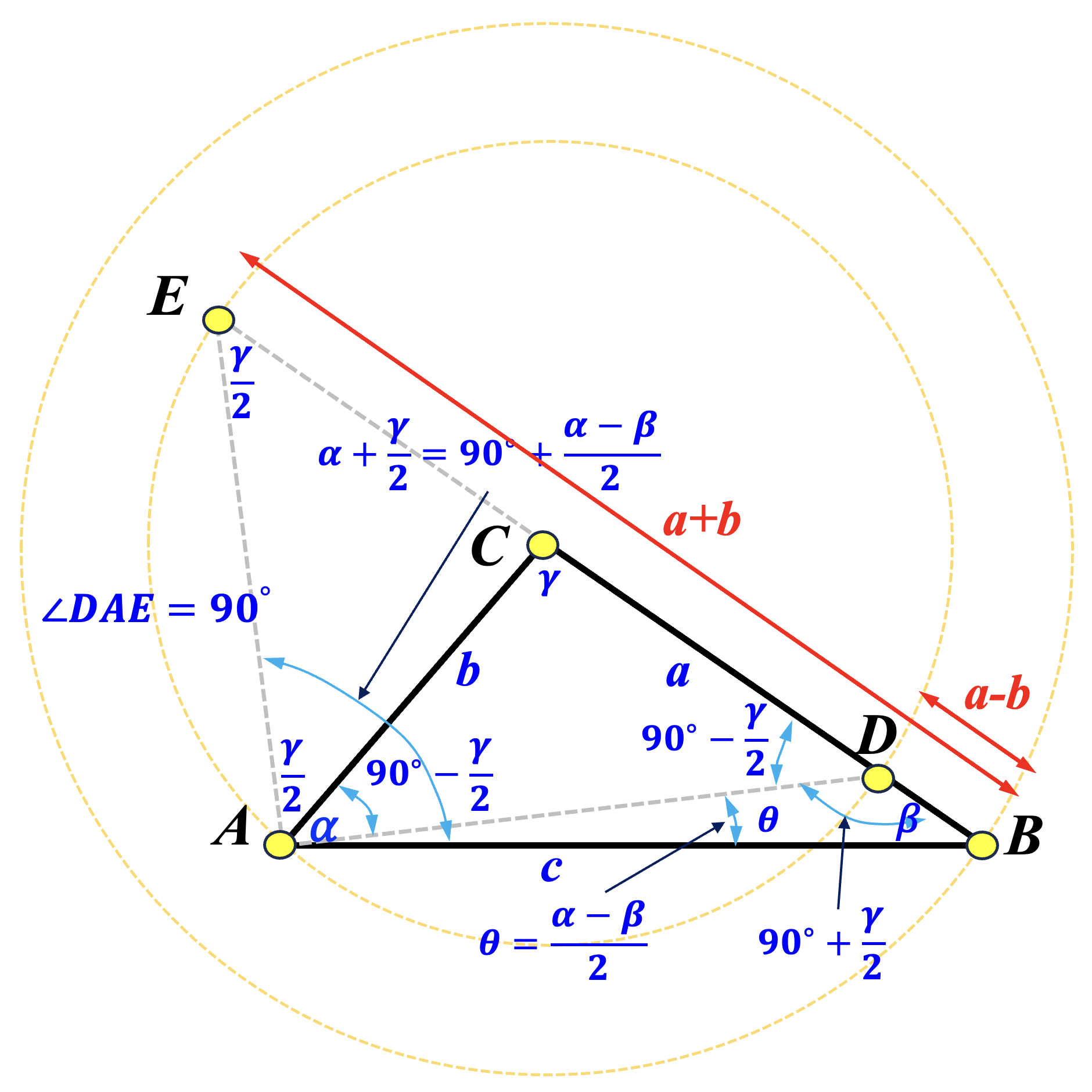
Case \( a > b \):
Use \( C \) as the center and length \( b =\overline{CA} \) as the radius
to draw a circle, which cuts the other side at \( D \) and \( E \)
so that \( \overline{CD} =\overline{CE} = b \).
Because \( a > b \), \( D \) is between \( B \) and \( C \).
In this way, we have \( \overline{BD}=a-b \) and \( \overline{BE} = a+b \).
Furthermore, because \( \overline{DE}\) is a diameter of the circle,
we have \( \angle DAE = 90^{\circ} \).
Because \( \bigtriangleup CDA \) is an isosceles triangle,
we have \( \angle CAD = \angle CDA = 90^{\circ} - \frac{\gamma}{2} \).
\( \bigtriangleup CAE \) is also an isosceles triangle,
and hence \( \angle CAE = \angle CEA = \frac{\gamma}{2} \).
Because we intend to apply the Law of Sines to \( \bigtriangleup ABD \),
we need to know the angle opposite to \( a-b \)
(i.e., \( \angle \theta = \angle BAD \))
and the angle opposite to \( c \)
(i.e., \( \angle BDA \)).
\( \angle BDA \) is simply
\[ \angle BDA = 180^{\circ} - \angle CDA = 90^{\circ} + \frac{\gamma}{2}. \]
For \( \theta = \angle BAD \), we have
$$
\begin{eqnarray*}
\theta &=& \angle BAD = \alpha - \left( 90^{\circ}-\frac{\gamma}{2}\right)
= \frac{2\alpha - 180^{\circ} + \gamma}{2} \\
&=& \frac{\alpha + (\alpha+\gamma)-180^{\circ}}{2}
= \frac{\alpha + \left( 180^{\circ}-\beta\right)-180^{\circ}}{2} \\
&=& \frac{\alpha-\beta}{2}
\end{eqnarray*}
$$
Now, the Law of Sines gives the following:
\[ \frac{a-b}{\sin(\theta)} = \frac{c}{\sin(\angle BDA)}. \]
Because \( \sin(\theta)=\sin\left( \frac{\alpha-\beta}{2}\right) \)
and because \( \sin(\angle BDA) = \sin\left( 90^{\circ}+\frac{\gamma}{2}\right)
= \cos\left( \frac{\gamma}{2} \right) \),
we have
\[ \frac{a-b}{\sin\left( \frac{\alpha-\beta}{2}\right)}=\frac{c}{\cos\left( \frac{\gamma}{2} \right)}. \]
Rearranging yields:
\[ \frac{a-b}{c}=\frac{\sin\left( \frac{\alpha-\beta}{2}\right)}{\cos\left( \frac{\gamma}{2} \right)}. \]
We shall use \( \bigtriangleup AEB \) to prove the second formula.
What we need is the angle opposite to
\( a+b=\overline{BE} \) (i.e., \( \angle BAE = 90^{\circ} + \theta
= 90^{\circ} + \frac{\alpha-\beta}{2} \))
and the angle opposite to \( c = \overline{AB} \)
(i.e., \( \angle AEB = \frac{\gamma}{2} \)).
Now, the Law of Sines gives:
\[ \frac{a+b}{\sin\left( 90^{\circ} + \frac{\alpha-\beta}{2}\right)}
= \frac{c}{\sin\left( \frac{\gamma}{2}\right)}. \]
Because \( \sin\left( 90^{\circ} + \frac{\alpha-\beta}{2}\right)
= \cos\left( \frac{\alpha-\beta}{2}\right) \),
we have
\[ \frac{a+b}{c} = \frac{\cos\left( \frac{\alpha-\beta}{2}\right)}{\sin\left( \frac{\gamma}{2}\right)}. \]
Case \( b < a \):
If an algebraic proof is preferred, the following is a simple one:
\[ \frac{a-b}{c} = -\frac{b-a}{c}
= -\frac{\sin\left(\frac{\beta-\alpha}{2} \right)}{\cos\left( \frac{\gamma}{2}\right)}
= \frac{-\sin\left(\frac{\beta-\alpha}{2} \right)}{\cos\left( \frac{\gamma}{2}\right)}
= \frac{\sin\left(\frac{-(\beta-\alpha)}{2} \right)}{\cos\left( \frac{\gamma}{2}\right)}
= \frac{\sin\left(\frac{\alpha-\beta}{2} \right)}{\cos\left( \frac{\gamma}{2}\right)}. \]
A geometric proof similar to the case of \( a > b \) is possible.
The circle with center \( C \) and radius \( b \)
intersects the other side at \( D \) and \( E \).
In this case, let the order be \( C-B-D \)
and hence we have \( \overline{BD}=b-a \).
Note that \( \angle DAE = 90^{\circ} \)
because \( \overline{DE} \) is a diameter.
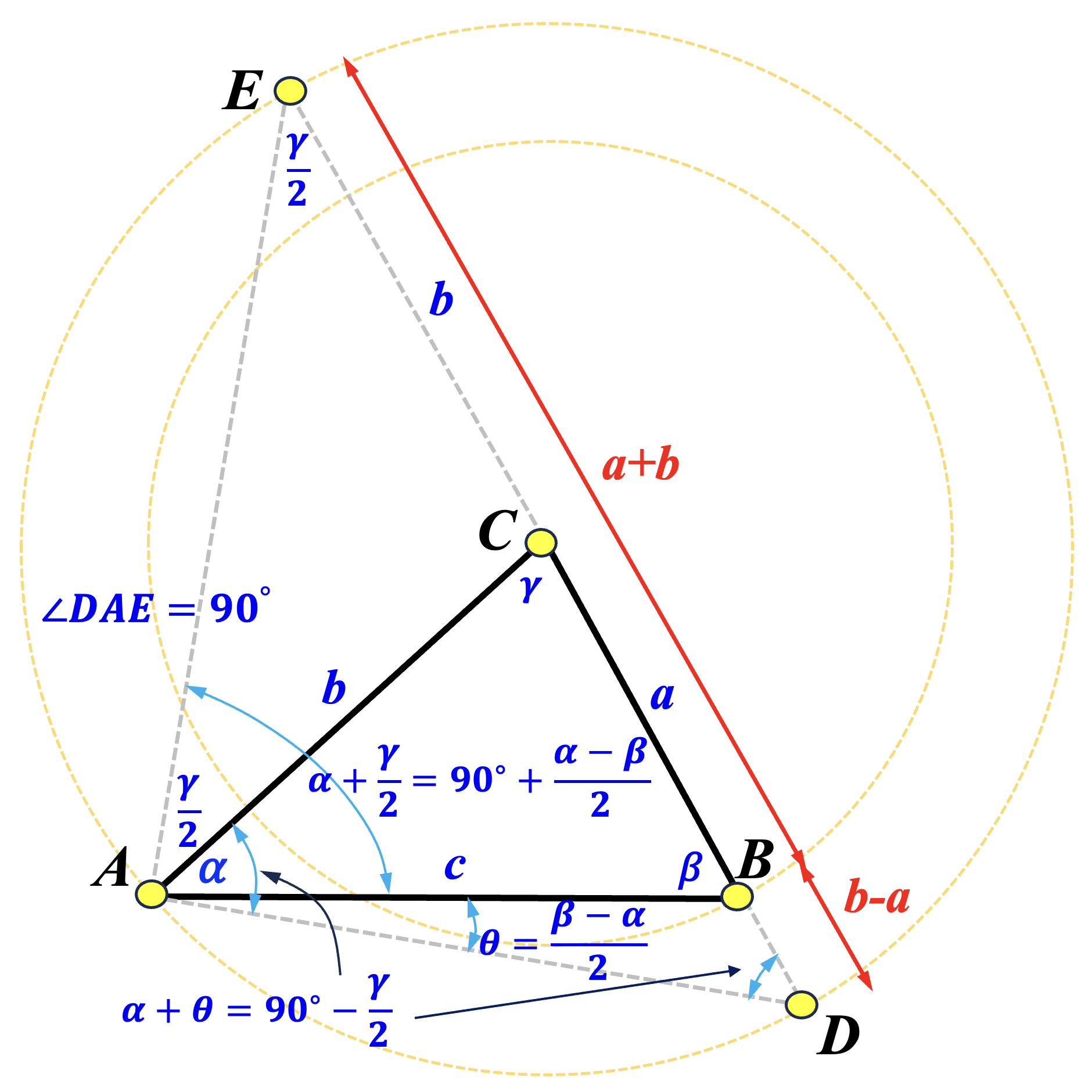
We shall apply the Law of Sines to \( \bigtriangleup ABD \).
Because \( \bigtriangleup CAD \) is an isosceles triangle,
we have \( \angle ADB = 90^{\circ} -\frac{\gamma}{2} \).
For \( \theta \), we have
\[ \theta = 90^{\circ} - \left(\alpha + \frac{\gamma}{2} \right)
= \frac{180^{\circ}-2\alpha - \gamma}{2}
= \frac{180^{\circ}-\alpha - (\alpha+\gamma)}{2}
= \frac{180^{\circ}-\alpha -(180^{\circ}-\beta)}{2}
= \frac{\beta-\alpha}{2}. \]
From \( \bigtriangleup ADB \), the Law of Sines gives
\[ \frac{b-a}{\sin\left( \frac{\beta-\alpha}{2}\right)}
= \frac{c}{\sin\left( 90^{\circ} - \frac{\gamma}{2}\right)}
= \frac{c}{\cos\left( \frac{\gamma}{2} \right)}. \]
Hence, we have:
\[ \frac{b-a}{c} = \frac{\sin\left( \frac{\beta-\alpha}{2}\right)}{\cos\left( \frac{\gamma}{2} \right)}\]
and consequently we have the desired result:
\[ \frac{a-b}{c}=-\frac{b-a}{c}
= -\frac{\sin\left( \frac{\beta-\alpha}{2}\right)}{\cos\left( \frac{\gamma}{2} \right)}
= \frac{\sin\left( \frac{\alpha-\beta}{2}\right)}{\cos\left( \frac{\gamma}{2} \right)}. \]
The second formula is proved using \( \bigtriangleup ABE \).
In this case, \( a+b = \overline{BE} \) and \( c = \overline{AB} \).
The angle opposite to \( a+b \) is
\[ \angle BAE = \alpha + \frac{\gamma}{2} = \frac{2\alpha+\gamma}{2}
= \frac{\alpha + (\alpha+\gamma)}{2}
= \frac{\alpha + (180^{\circ}-\beta)}{2}
= 90^{\circ} + \frac{\alpha-\beta}{2}. \]
Thus, \( \sin(\angle BAE) = \sin\left( 90^{\circ} + \frac{\alpha-\beta}{2}\right)
= \cos\left( \frac{\alpha-\beta}{2}\right) \).
Applying the Law of Sines to \( \bigtriangleup BAE \), we have
\[ \frac{a+b}{\sin(\angle BAE)} = \frac{c}{\sin\left( \frac{\gamma}{2} \right)} \]
Finally, we have the desired result:
\[ \frac{a+b}{c} = \frac{\cos\left( \frac{\alpha-\beta}{2}\right)}{\sin\left( \frac{\gamma}{2} \right)}. \]
It is not difficult to prove the same without using the Law of Sines.
Please see the next section.
Proofs without Using the Law of Sines
It is very easy to avoid the use of the Law of Sines.
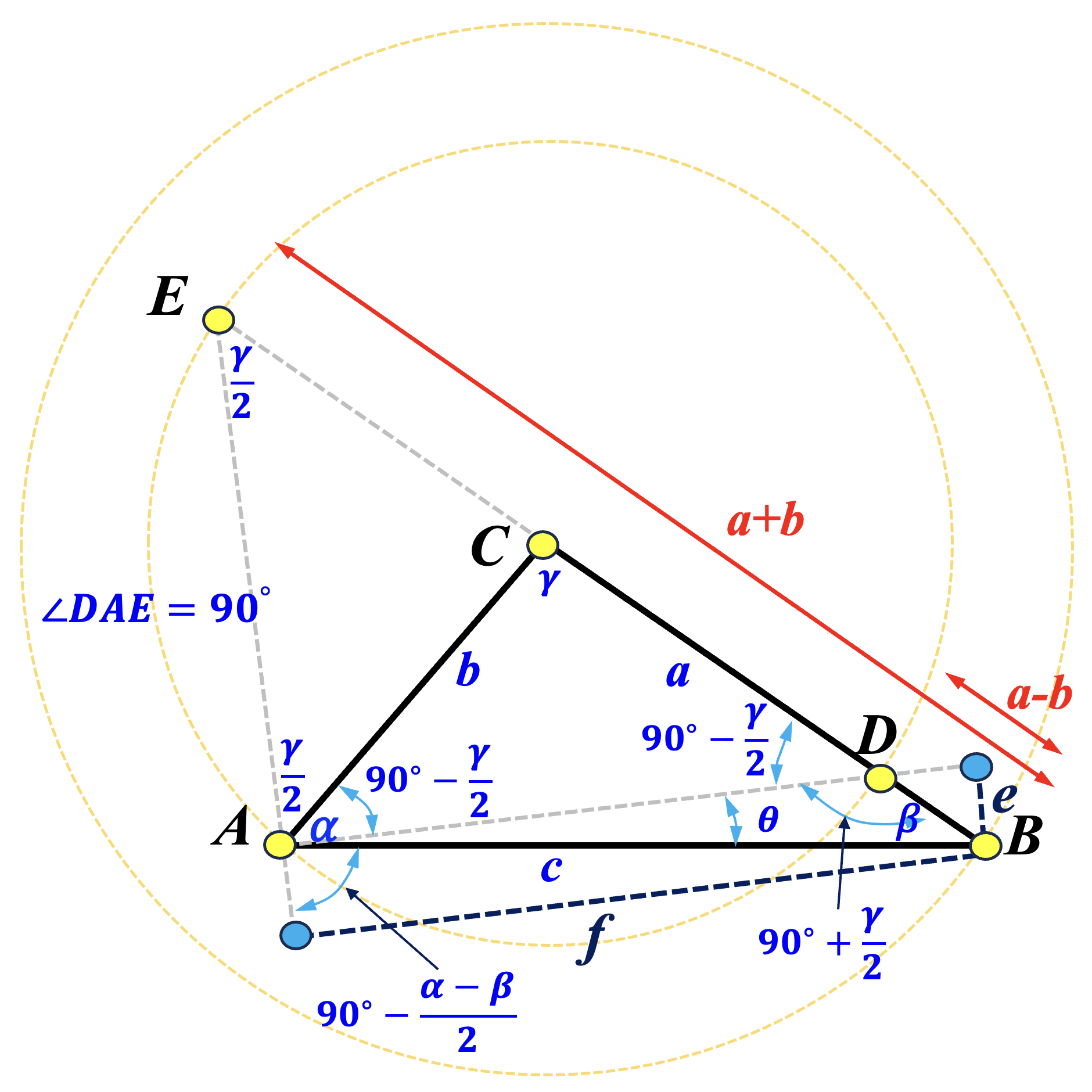
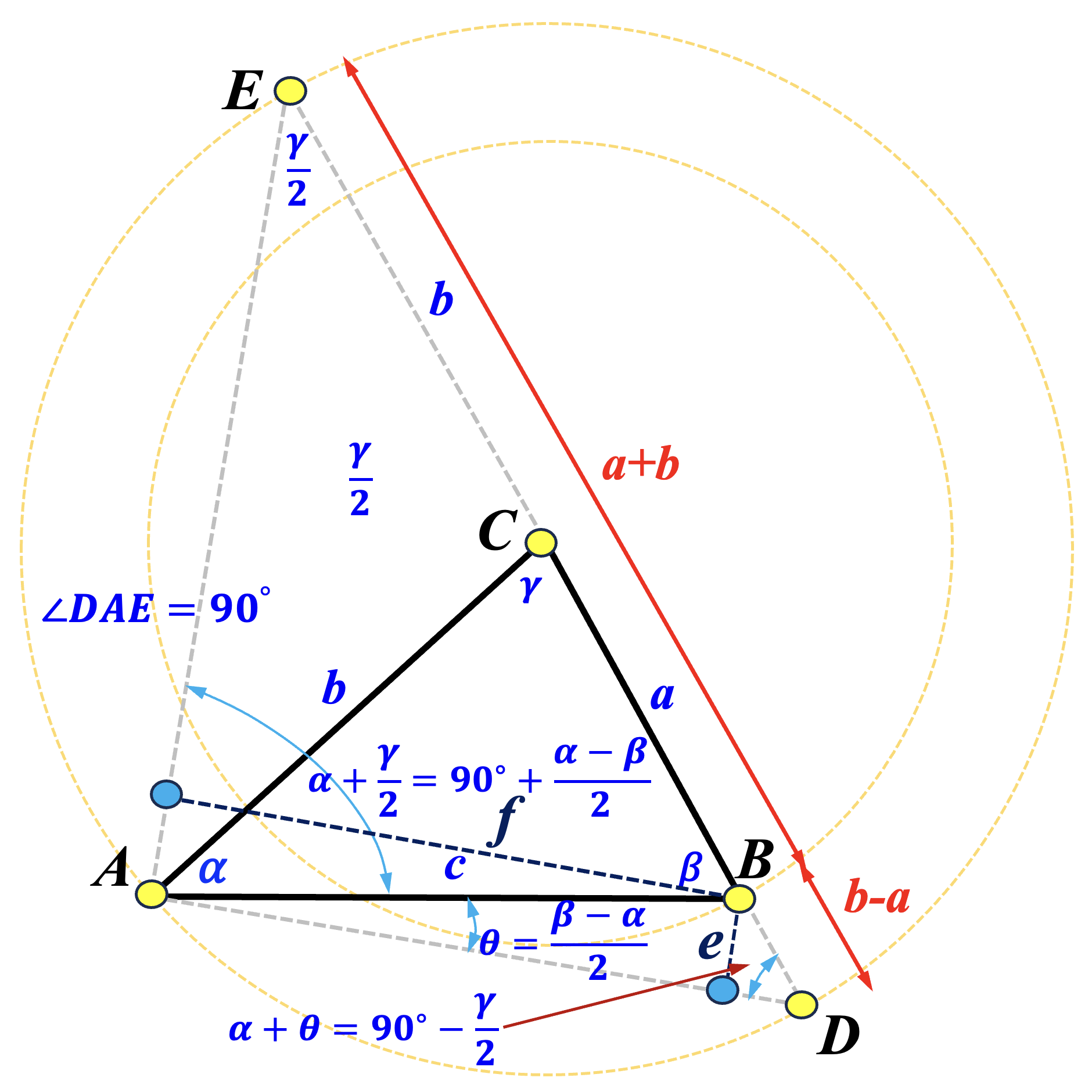
Let the distances from \( B \) to \( \overleftrightarrow{AD} \)
and \( \overleftrightarrow{AE} \) be \( e \) and \( f \), respectively.
If \( a > b \) (left diagram below), we have
\[ e = \overline{DB}\cdot\sin\left( 90^{\circ}-\frac{\gamma}{2}\right)
= (a-b)\cos\left( \frac{\gamma}{2}\right) \]
and
\[ e = \overline{AB}\cdot\sin(\theta)=c\cdot\sin\left( \frac{\alpha-\beta}{2} \right). \]
Hence, we have
\[ (a-b)\cos\left( \frac{\gamma}{2}\right) = e
= c\cdot\sin\left( \frac{\alpha-\beta}{2} \right). \]
Now, \( f \) is calculated as follows:
\[ f = (a+b)\sin\left( \frac{\gamma}{2} \right) \]
and
\[ f = c\cdot\sin\left( 90^{\circ}-\frac{\alpha-\beta}{2} \right)
= c\cdot\cos\left( \frac{\alpha-\beta}{2} \right). \]
Hence, we have the desired result:
\[ (a+b)\sin\left( \frac{\gamma}{2} \right) = f
= c\cdot\cos\left( \frac{\alpha-\beta}{2} \right). \]
 The Case of \( a > b \)
|
 The Case of \( b > a \)
|
The above right diagram is for the \( a < b \) case.
In this case, we have
\[ e = (b-a)\sin\left( 90^{\circ}- \frac{\gamma}{2} \right)
= (b-a)\cos\left( \frac{\gamma}{2}\right) \]
and
\[ e= c\cdot\sin\left( \frac{\beta-\alpha}{2}\right) \]
Therefore, we have the first formula:
\[ (b-a)\cos\left( \frac{\gamma}{2}\right) = e
= c\cdot\sin\left( \frac{\beta-\alpha}{2}\right). \]
Now, we consider \( f \):
\[ f = (a+b)\sin\left( \frac{\gamma}{2} \right) \]
and
\[ f = c\cdot\sin\left( 90^{\circ}+\frac{\alpha-\beta}{2}\right)
= c\cdot\cos\left( \frac{\alpha-\beta}{2} \right). \]
Hence, we have the second formula:
\[ (a+b)\sin\left( \frac{\gamma}{2} \right) = f
= c\cdot\cos\left( \frac{\alpha-\beta}{2} \right). \]
Discussions
I personally like the algebraic proof more than the geometric one,
because it does not have to deal with special cases.
There are other geometric proofs available,
published and on the web,
most of them only address the case of \( a > b\)
and did not even mention the case of \( a < b\).
This is particularly true for those PWW (i.e., proof-without-word) type proofs.
Due to its diagrammatic nature,
PWW proofs usually shows a single diagram, which is perhaps the most obvious and easiest case
and the authors seem hesitate to explain how the lengths and angles
are obtained.
As a result, some PWW proofs are not so easy to understanding
while some others lack of generality.
The proof of Mollweide's Formula is a good example.
This is the major reason for me to discuss the proof using the Law of Sines first.
Comparing this algebraic proof with the geometric proof, which includes both cases,
the algebraic one is not only easier but also straightforward and general.
Note that the seond Mollweide's formula is usually referred to as Newton's Formula.
For more history regarding Mollweide's Formulas,
please refer to this short article by Rex H. Wu (2007):
The Story of Mollweide and Some Trigonometric Identities.
This article also includes a few proofs.
You may also like Karjanto's Mollweide’s formula in teaching trigonometry.
The proof presented here deals with both cases: \( a > b\) and \( a < b\).
I just dislike to present anything that is half-baked.
From Mollweide Formulas, it is easy to proof the Pythagorean Theorem
and the Law of Tangents.
Go back to
Home Page.