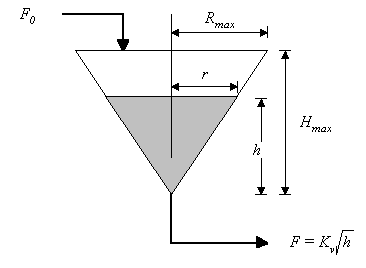
Figure 1. Conical Tank System.
Due Jan. 19, 2005 5pm
(For the simulations, you may use the spreadsheet to implement Euler methods. A tutorial (click here) is available in the web. )
1. A liquid of constant density is fed at a constant volumetric rate Fointo a conical tank of height Hmax
and maximal radius Rmax. The flow out of the tank is Kvh1/2 where h is the height of the liquid in the
tank and Kv is the valve coefficient (see Figure 1)
Figure 1. Conical Tank System.
a. Obtain a dynamic model which describes the height of liquid in the tank.
b. By analyzing the mathematical model (you do not need to solve the differential equation),
how is the steady state value of h affected by changing Fo ? Kv ? Rmax?
and Hmax? Explain.
c. What is the effect of changing Rmax on the rate of change of h ? Why do you expect this ?
d. Using Euler method, simulate the system in order to verify your predictions using the
following nominal parameters:
Rmax 5 ft Hmax 10 ft Kv 1 ft2 ft1/2/ s h(0) 2 ft Fo 2 ft3/s
To check the effects of Rmax on steady state and rate
of response, vary the values
of Rmax to 3, 4, 5, 6 and 7 ft. Next, put Rmax
back to 5 ft and check the effects of
changing valve coefficient Kv to 0.9, 1.0 and 1.1.
After putting Kv back to 1.0,
investigate the effects of the feed rate Fo to 1.7,
2, and 2.3 ft3/s. Finally, set Fo back
to 2.0 ft3/sand investigate the effects of starting the
simulation at different initial
conditions, i.e. h(0) at 3, 4 and 5 ft. Make sure that the time
length of your simulation
should at least go far enough to observe steady state conditions.
2. First order linear systems. Liquid is fed to a storage tank in which the tank level (hence
Changes in Variable Effect on Steady State Effect on Response Time As x increases :
Increases :
Shorter :
also tank volume) is held constant by a control system (not shown) in Figure 2
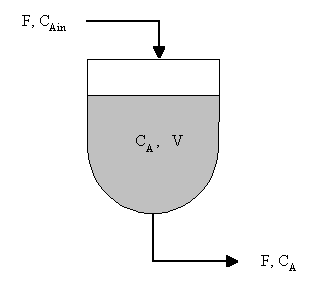
Figure 2. Storage Tank at Constant Volume
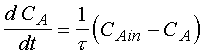
b. Simulate the system using Euler method for the following parameters:
| t | 1 sec |
| CAin | 0.2 lb/ft3 |
| CA(0) | 0.1 lb/ft3 |
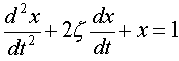
a. Obtain the analytical solution, x(t), by solving the differential
equation for the
following cases: z=1.5,
0.5 and -0.1. ( click here
for a short review on solving high
order linear ODEs and click here
for an example of solving a second order ) .
Plot your solutions for x(t) of each case
from
t=0 to 25 and
summarize your observations for the three plots.
( I suggest obtaining a plot
that overlays the three curves in one figure for
easier comparison. )
b. Now use Euler's method to obtain a numerical solution from
t=0
to 25.
( I suggest using a sample time interval of 0.01.)
To extend the method for higher order differential equation,
one needs to
first rewrite the equation to a set of first order
differential equations. For
instance, first introduce an auxiliary variable,
y, as follows:

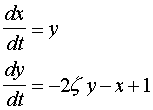
Compare your numerical solutions (using Euler method)
with your analytical
solutions for the cases where z=1.5,
0.5 and -0.1, to assess the accuracy
of the Euler method.
Note: the parameter z
is known as the damping coefficient and it is used to
indicate whether oscillations are present or not.
Summarize your observations.
Perform one spreadsheet simulation of the process given in 2b using
one of the cases,
say t = 1.0, all the way to where a plot
of the response has been drawn.
Now try including a scrollbar (click here
for a short tutorial) that would manipulate
the value of t from 0.5 to 5. You
should be able to slide the scrollbar using the mouse
and concentrate on how the response changes, without being distracted
by
keyboard-inputs to change t.