1.4 Homework
MA 2321, Fall '03, T. Olson
- 2.
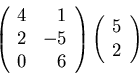
- If defined, compute the product shown using
(i) the definition (linear combinations of columns) and
(ii) the rule for computing
 .
If the product is undefined, say why.
.
If the product is undefined, say why.
- 4.
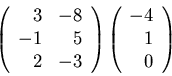
- If defined, compute the product shown using
(i) the definition (linear combinations of columns) and
(ii) the rule for computing .
If the product is undefined, say why.
- 8.
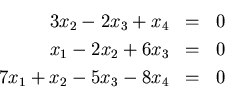
- Write the system in the form
 .
.
- 19.
- Let
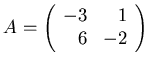 and
and
 .
Show that the equation
is not consistent
for all possible
.
Show that the equation
is not consistent
for all possible  ,
and describe the set of all
for which
is consistent.
,
and describe the set of all
for which
is consistent.
- 31.
- It can be shown that
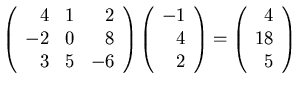 .
Use this fact (and no row operations) to find scalars
c1, c2, and c3, such that
.
Use this fact (and no row operations) to find scalars
c1, c2, and c3, such that
- 32.
- Let
 ,
,
 ,
and
,
and
 .
It can be shown that
.
It can be shown that
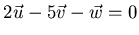 .
Use this fact (and no row operations) to solve the equation
.
Use this fact (and no row operations) to solve the equation
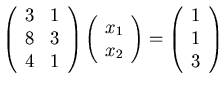 .
.
- 35.
- Let A be a
 matrix, let
  and
and
 be vectors in
 ,
and let
,
and let
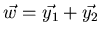 .
Suppose that
.
Suppose that
 and
and
 for some vectors
  and
and
 in
in
 .
What fact allows you to
conclude that the system
.
What fact allows you to
conclude that the system
 is consistent?
(Note,
and
denote vectors, not
scalar entries in vectors.)
is consistent?
(Note,
and
denote vectors, not
scalar entries in vectors.)
- 36.
- Let A be a
 matrix, and let
  be a vector in
and
be a vector in
and  a vector in
 .
Suppose that
.
Suppose that
 .
What fact allows you to conclude that the system
.
What fact allows you to conclude that the system
 is consistent?
About this document ...
Tamara Olson
trolson@mtu.edu