Can we make it rain? The question is deceptively simple, but like many seemingly simple queries, it has a nuanced answer. Research over the past 70 years shows that we can, in fact, make it rain (or snow). However, that same body of research also shows that the very steps we take to enhance precipitation might decrease, or worse, prevent it. The complete answer to “Can we make it rain?” isn’t “yes” or “no”—it is, instead, “Maybe.”
You must know which clouds will be susceptible to intervention, and you must know which interventions will be effective. We address some of those fundamental questions in order to make operational precipitation enhancement more reliable.
Our primary tools are the Michigan Tech Pi Chamber—a one-of-a-kind facility where we can create and sustain turbulent cloud conditions for hours at a time—and state-of-the-art modeling platforms, which enable us to extend our understanding of the experiments in the chamber.
Objectives
Polluted clouds
High droplet number concentration; small droplet size
- Understand the response to hygroscopic seeding materials, salt and NaCl-TiO2 in particular.
- Understand the response to dust.
- Understand the response to hygroscopic flare material, used operationally in cloud seeding efforts.
- Understand the response to the introduction of charge.
Moderately clean clouds
Moderate droplet number concentration
- Understand the response to hygroscopic seeding materials, salt and NaCl-TiO2 in particular.
- Understand the response to dust.
- Understand the response to hygroscopic flare material, used operationally in cloud seeding efforts.
- Understand the response to the introduction of charge.
Midproject Site Review
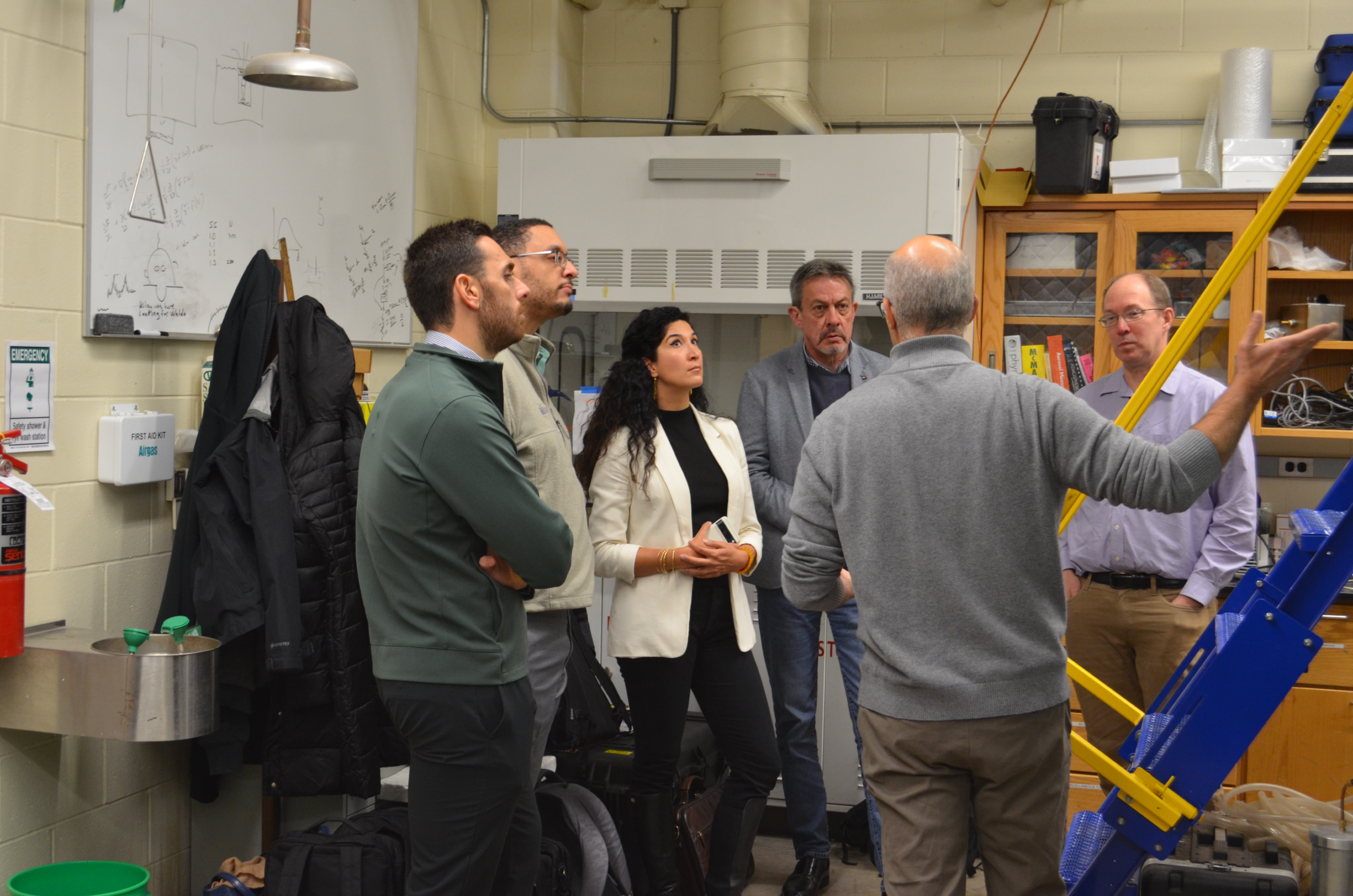
The midproject site review was held September 3–5, 2025. Michigan Tech hosted four members of the review panel, along with collaborators from Mesa Photonics and Weather Modification International; collaborators from the University of Utah participated remotely.
The visit coincided by design with the start of the second phase of intensive experiments in the chamber. During the review, Raymond Shaw explained chamber operations to members of the review team and Cantrell.