Mechatronics Portal
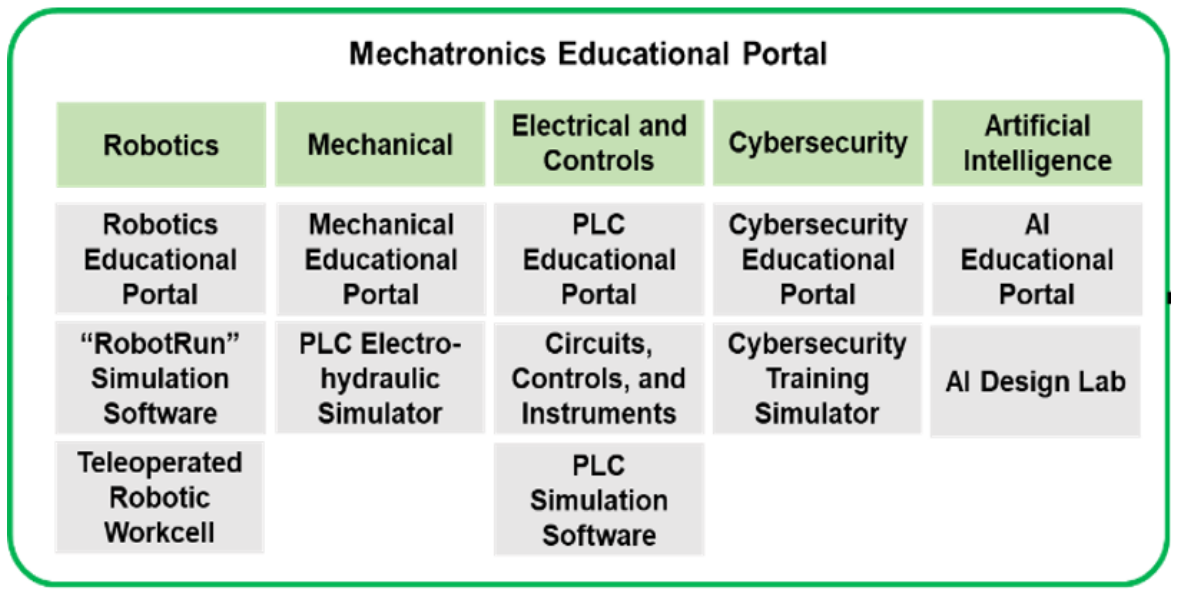
The Mechatronics educational portal stands on the five pillars of a mechatronics foundation: robotics, mechanical, controls, cybersecurity, and artificial intelligence. Each pillar includes theoretical modules on the subject matter and relevant simulation, virtual training tools to enable laboratory exercises.
Robotics
The Robotics Educational portal (REP) is comprised of the "RobotRun" robotic simulation software, robotic tutorials, and online lectures. The robotic tutorials are established assuming the user has limited initial robotics knowledge. Participants will use online lectures to complement the tutorials, and industry-like scenarios incorporated into the "RobotRun" software allow simulation of current industrial processes and effective teaching of concepts of industrial robotics. Incorporated scenarios include advanced manufacturing industrial processes, such as robotic line assembly, robot-assist welding, material handling, palletizing, gluing, and sealant application. Teleoperated Robotic Workcell (TRW): consists of a Fanuc collaborative robot, three cameras for real-time feedback to the user, and a computer server to host the developed software. The interface for the client consists of the virtual teach pendant with an overlaid display screen of the real teach pendant and two display windows showing the robot from different angles transmitted by the cameras installed in the physical robotic workcell. The TRW enables remote access to the robot by users from anywhere in the world via the internet in a safe environment.
Mechanical
The main component of the Fluid Educational Portal (FEP) manufacturing curriculum for mechatronic systems is the use of fluid power in automated systems. This includes a virtual(online) effort and a hands-on effort. The virtual effort is comprised of FEP and Electrohydraulic System Simulator are carried out in a virtual environment. This is accomplished in an online setting comprised of video explanations, example calculations, and example simulations. The hands-on effort comprises basic hand calculations, laboratory demonstrations, and experiments at Michigan Technological University using fluid power trainers and specialty-designed systems. The online component includes the following topics: introduction to hydraulics and hydraulic theory; explanation of hydraulic actuators, valves, and components; hydraulic fluids; explanation of electro-hydraulics; hydraulic simulation methods The hands-on part of the training covers the topics of safety review; introduction to the Hydraulic Lab and hydraulic trainers; hydraulic circuit components and hose connections; basic alculations for hydraulic components and circuits; hydraulic circuit demonstration; and electro-hydraulic circuit demonstration.
Electronics and Controls
Programmable Logic Controllers Educational Portal (PLCEP): PLCs play a crucial role in advanced manufacturing and are utilized as industrial computers to control and optimize industrial processes, communicate data, and solve mathematical functions. The knowledge of PLC programming is crucial for mechatronics specialists. The participants will utilize a set of open-source and online learning modules designed to give students interactive, hands-on experience with programming PLCs on a standard desktop or laptop computer. The learning modules include multimedia materials that introduce the content. The learning process is enhanced by PLC Simulation Software, which encompasses introductory and advanced PLC topics. It incorporates predefined programming scenarios and a sandbox programming style where the users can examine their skills while defining and executing individual problems.
Advanced Circuit Controls and Instrumentation (ACCI): Individuals trained in designing, analyzing, and enhancing advanced circuits and control systems are in high demand in the industry. The main mechatronics objectives are the interdisciplinary skills to manipulate a complex control system and measure variables with instruments. The developed modules are divided into two parts. The first portion focuses on introducing the basics of electronics and circuit analysis. Students learn basic definitions via online lectures and incorporate their knowledge in the labs with hands-on experiments.
After learning basic electronics, they will be introduced to control systems. The modules will start with a simple control system and then add feedback. The last part will focus on PID control systems. Students will learn the basic theory of control systems via online modules, and then they will use their knowledge to complete hands-on experiments and tune PID controllers.
Cybersecurity
Cyberattacks are becoming more common, sophisticated, and damaging as the proliferation of Mechatronics technologies become more interconnected. Hence, there is a pressing need for a well-trained and well-prepared cybersecurity workforce. Developed via this ExLENT project, these modules will provide hierarchical knowledge of cybersecurity threats to Industrial Control Systems (ICS) and the security controls to mitigate those threats. Students will be provided with simulated demonstrations and practice in best practices for cybersecurity. Importantly, the educational modules will be tailored to participants with no deep background in cybersecurity or ICS. Hence, this project aims to provide participants with the ability to conduct cybersecurity best practices and recognize sophisticated cybersecurity threats.
Artificial Intelligence (AI)
AI is becoming an essential tool for modern industrial processes involving technologies in electrical, mechanical, computer, robotic, control engineering, and cybersecurity. While Industry 4.0 brings new technologies, the industry faces challenges of the shortfall of skilled workers in AI, particularly to service advanced Mechatronics technologies. To address this issue, the participants will be introduced to the fundamental concepts in AI, software implementation with Python programming, and advanced applications, including production analytics and vision-based robotics. Hence, the ExLENT project aims to provide the next diverse generation workforce with capabilities to understand, formulate, and deploy AI algorithms in Mechatronics.