Elements: Book II Propositions 12 and 13 (II.12 and II.13)
Euclid's Scissors
Ching-Kuang Shene (冼鏡光), Professor Emeritus
Department of Computer Science
Michigan Technological University
Houghton, MI 49931
USA
Created March 23, 2026

We discussed Euclid's Scissors on a
previous page.
We shall use this method or procedure/algorithm to prove
II.12 and II. 13 in Elements.
Given a \( \bigtriangleup ABC \) with sides \( a = \overline{BC} \), \( b = \overline{CA} \)
and \( c = \overline{AB} \),
a pair of Euclid's Scissors can be defined at each vertex.
Each vertex of a triangle has two adjacent triangle sides and one side from a square.
A pair of Euclid's Scissors is formed by two congruent triangles sharing a selected vertex.
Suppose the selected vertex is \( B \)
(the first disgram below).
Each of the adjacent sides (i.e., \( \overline{BC} \) and \( \overline{AB} \))
belongs to a triangle of the scissors
and the side of a square that is perpendicular to an adjacent side
belongs to the other triangle of the scissor.
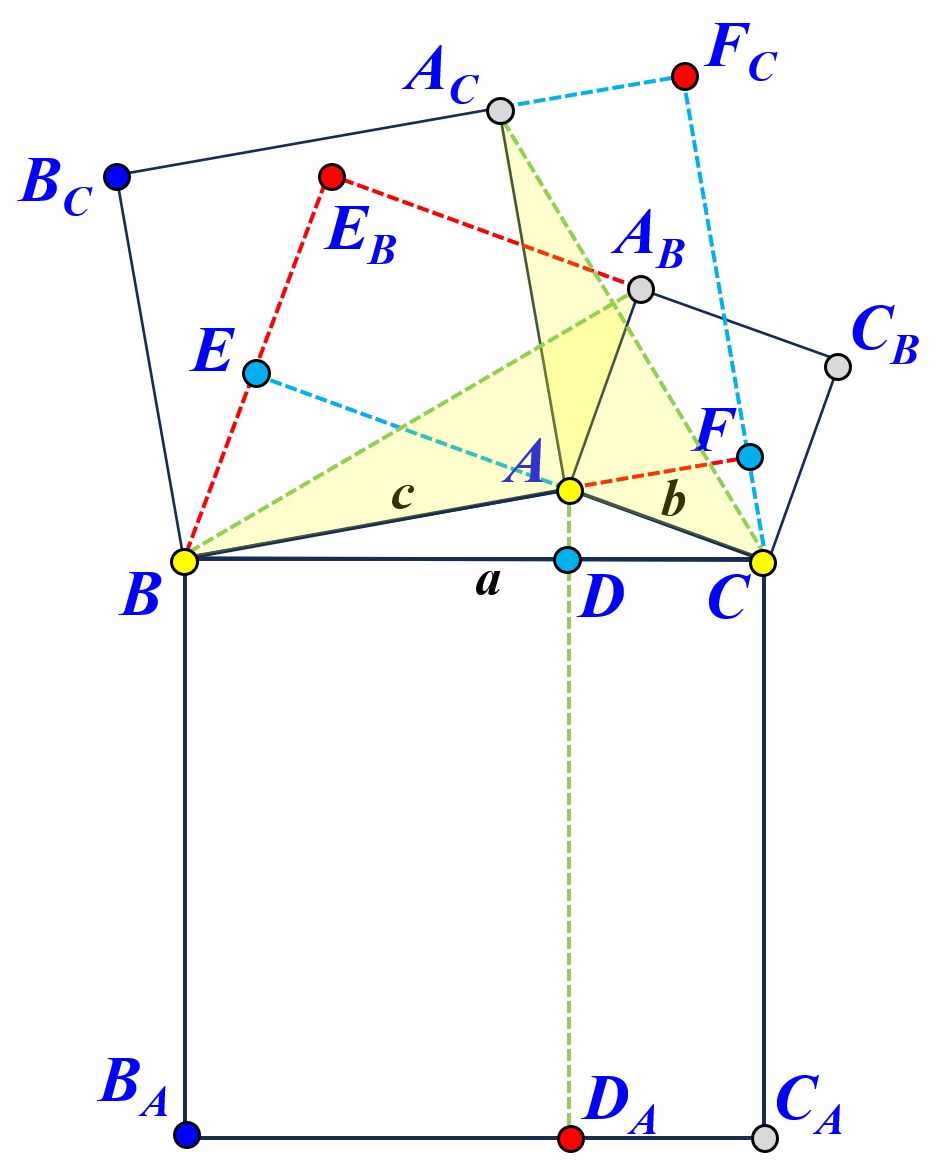
Suppose the squares on side \( \overline{BC} \), \( \overline{CA} \) and \( \overline{AB} \)
are \( BCC_AB_A\), \(CAA_BC_B\) and \( ABB_CA_C \), respectively.
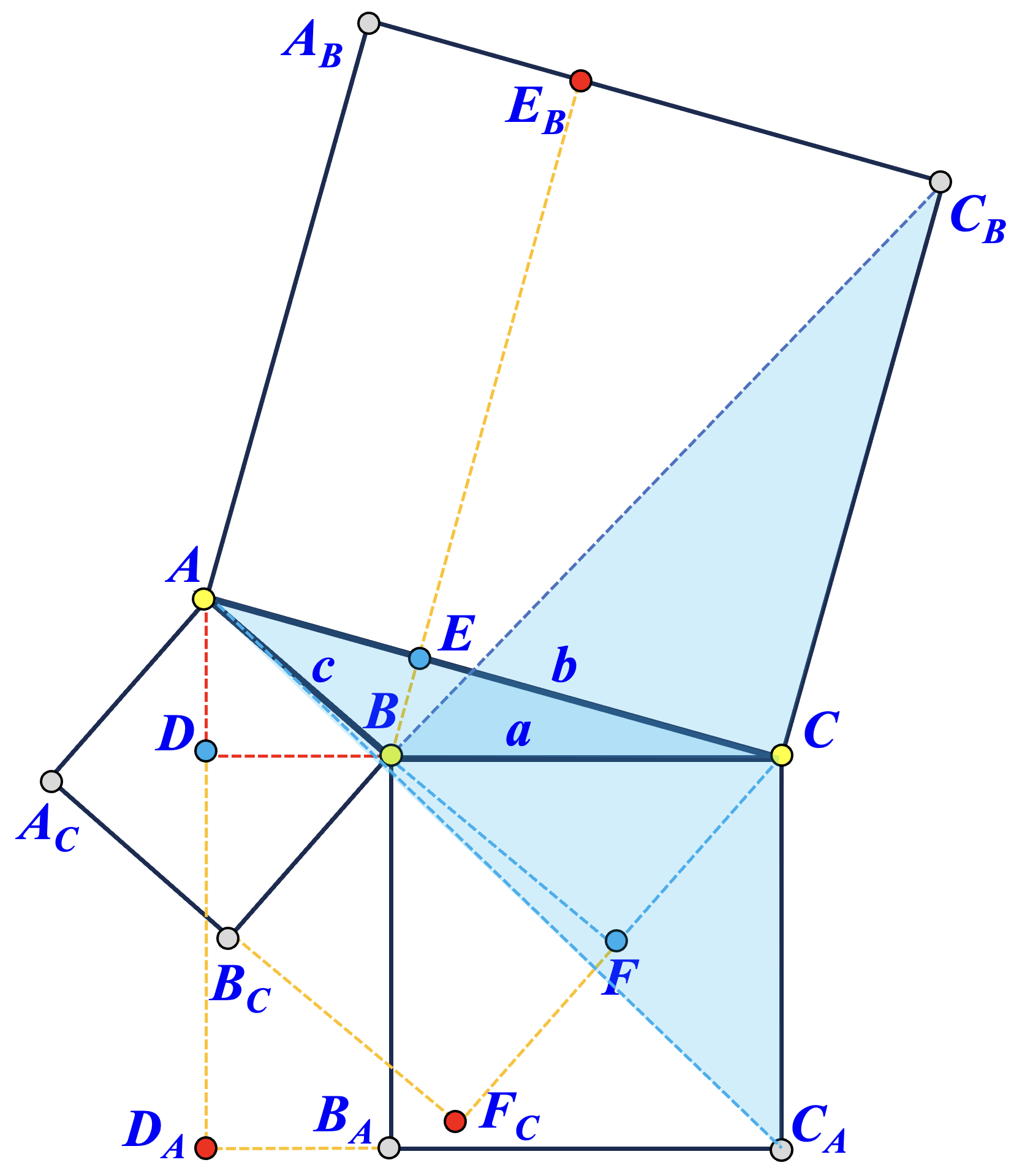
The scissors at \( B\) are congruent triangles \( \bigtriangleup BCB_C \)
and \( \bigtriangleup BAB_A \).
One sidce of \( \bigtriangleup BCB_C \) (resp., \( \bigtriangleup ABB_A \))
is from an adjacent side \( \overline{BC} \) (resp., \( \overline{AB} \))
and the other side
\( \overline{BB_C} \) (resp., \( \overline{BB_A} \)) is the side of the square perpendicular to the other adjencent side.
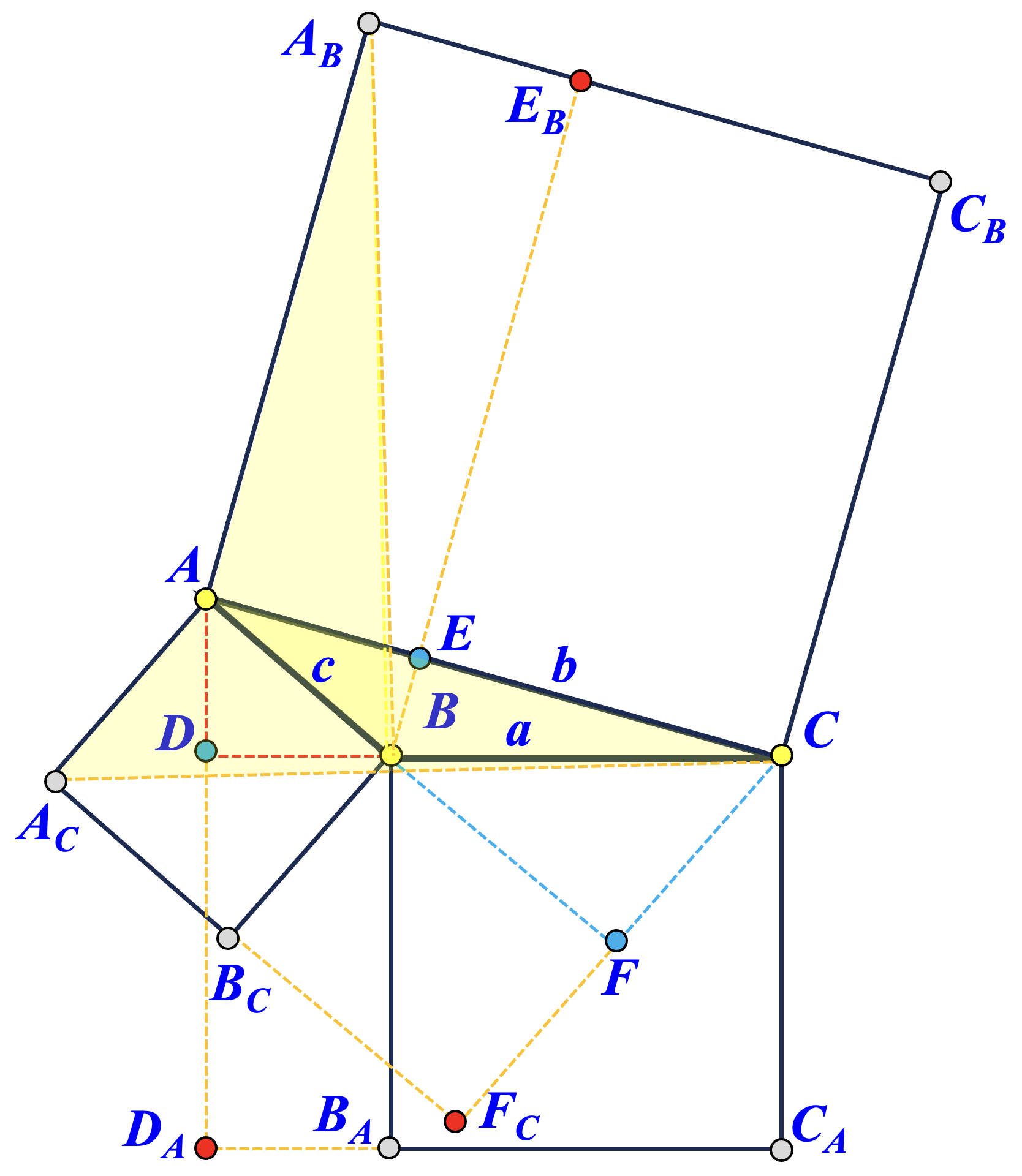
The following diagrams show the scissors at \( B \), \( C \) and \( A \).
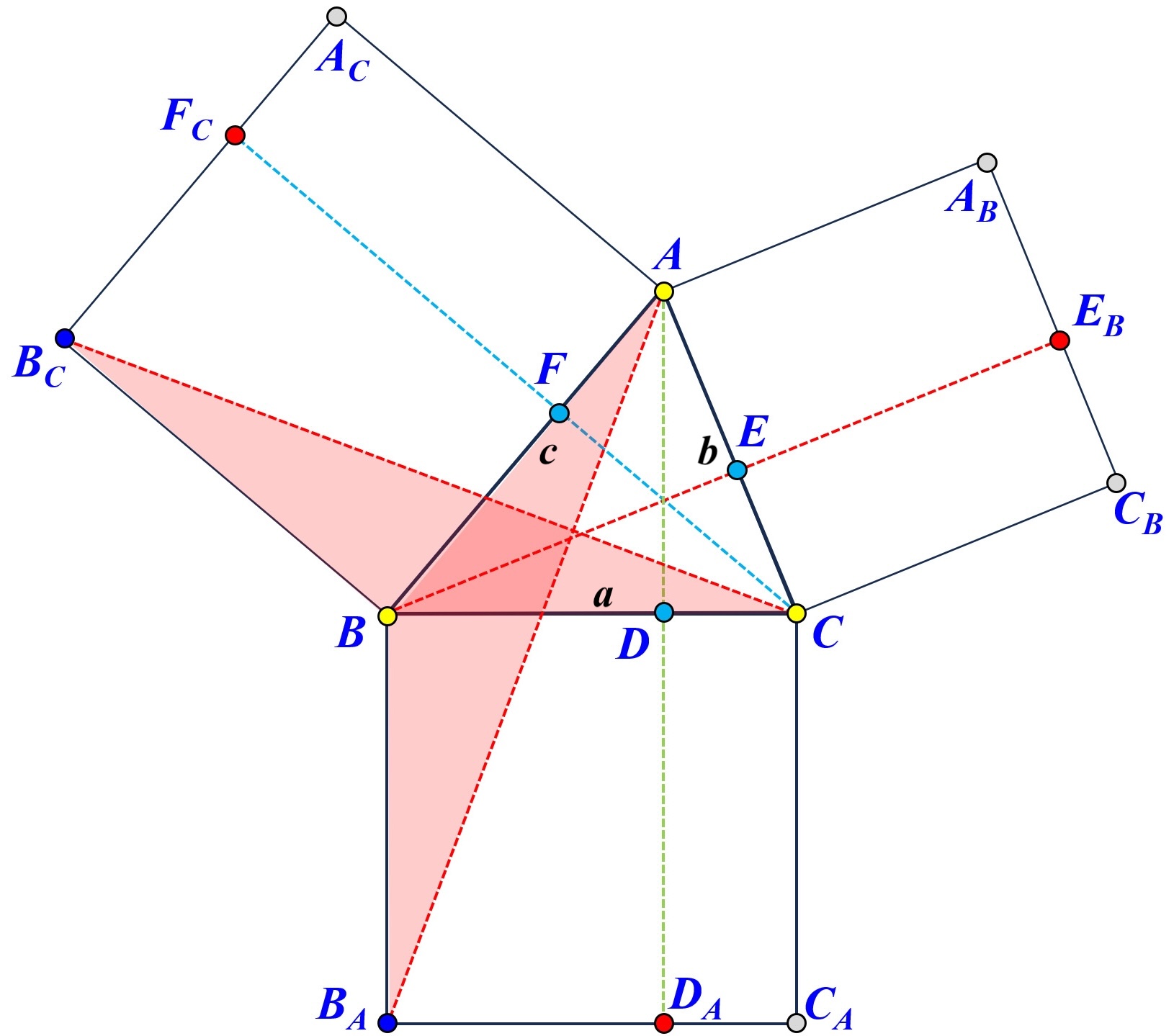 The Scissors at \( B \)
|
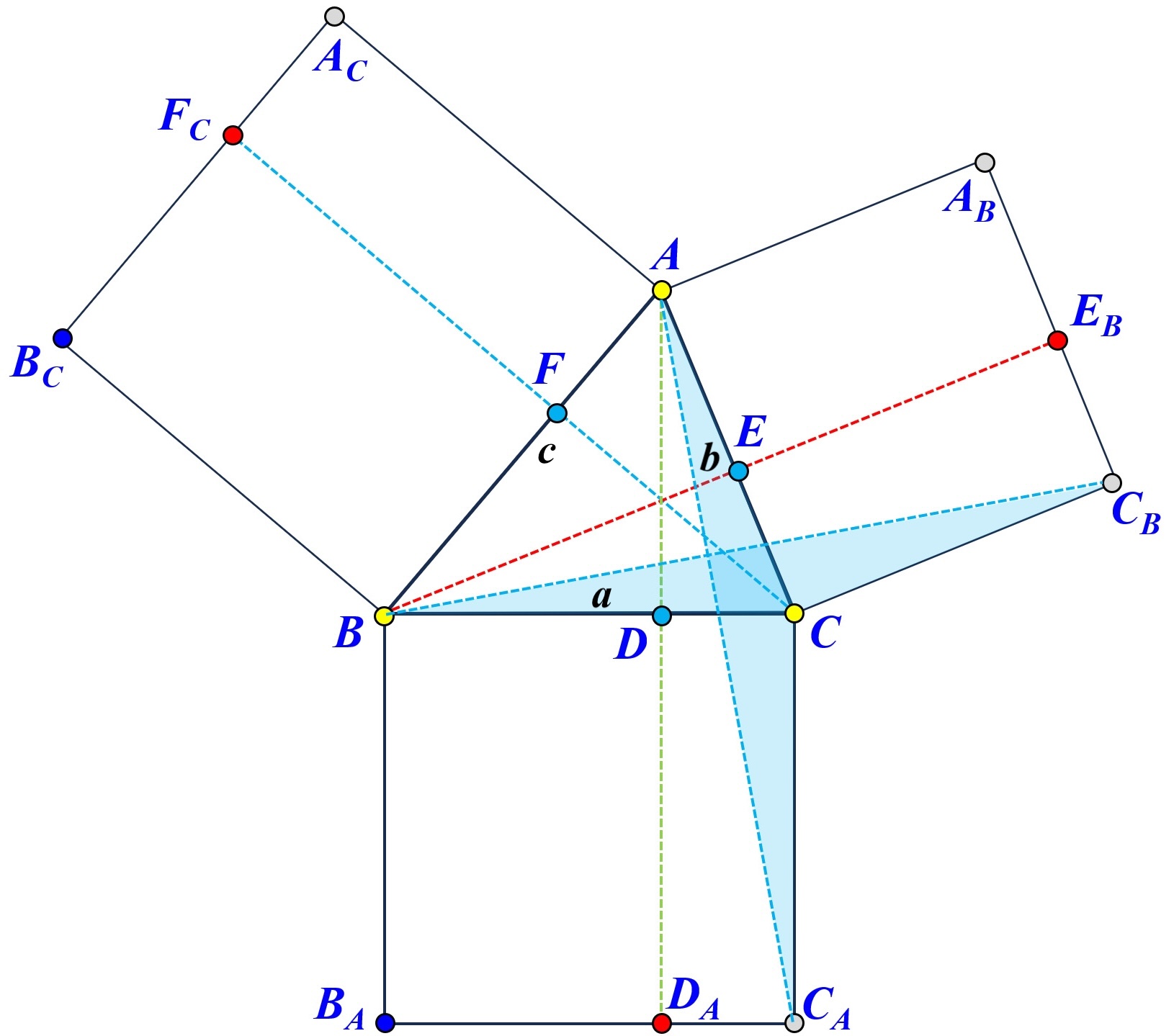 The Scissors at \( C \)
|
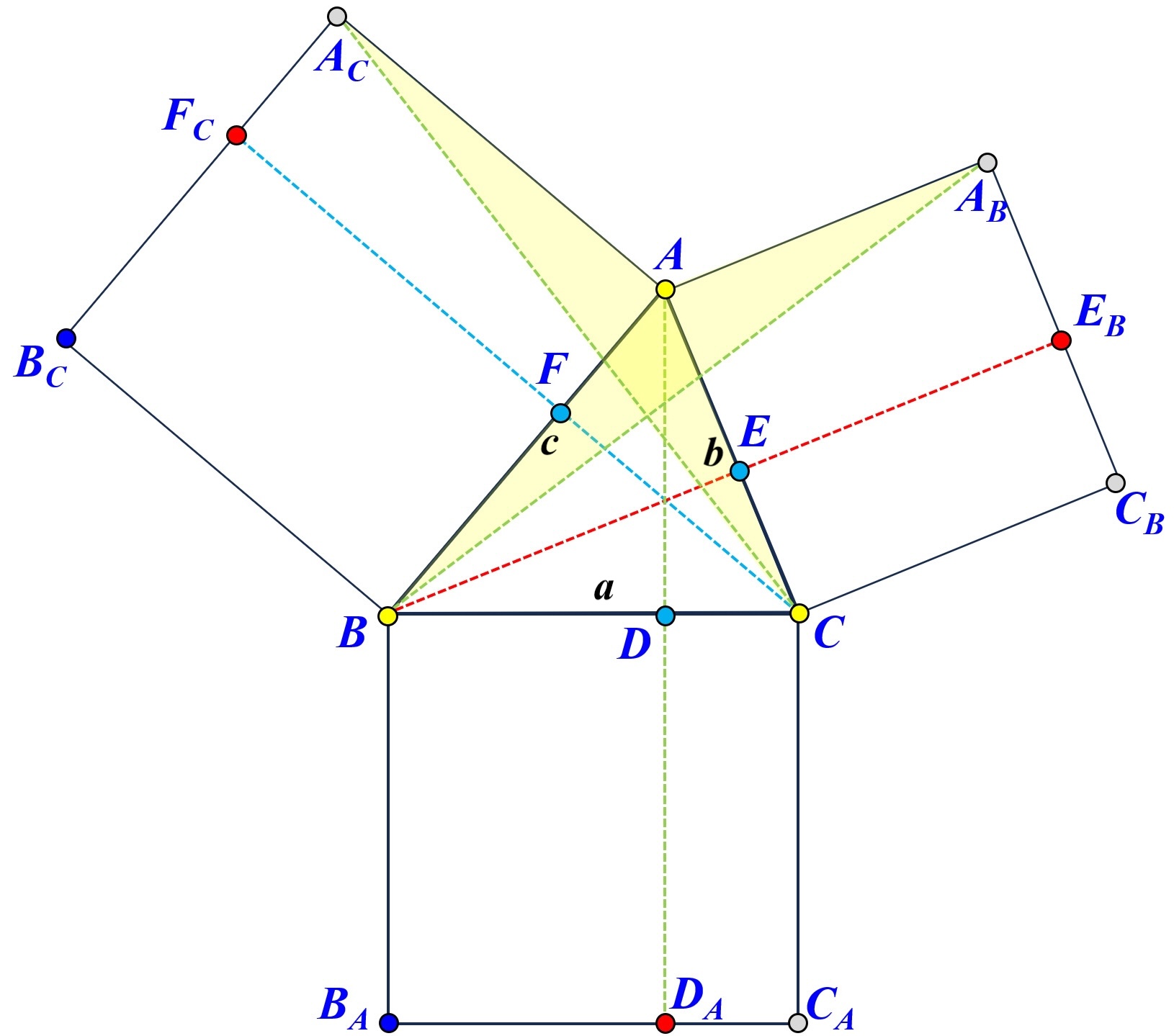 The Scissors at \( A \)
|
Each pair of scissors is associated with two rectangles of equal area,
one on each side of the scissors.
We used this fact to prove the Pythagorean Theorem.
Again, let \( B \) be the selected vertex.
Drop a perpendicular from each of the other two vertices to its opposite side,
cutting the square on the opposite side into two rectangles.
For example, \( \overleftrightarrow{CF} \) cuts the square \( ABB_CA_C \)
into rectangles \( BFF_CB_C \) and \( AFF_CA_C \),
where \( F \) and \( F_C \) are the perpendicular feet on \( \overline{AB} \)
and \( \overline{A_CB_C} \), respectively.
The area of rectangle \( BFF_CB_C \) is twice of that of triangle \( \bigtriangleup CBB_C \)
and is the same as that of \( ABB_A \).
Similarly, the area of rectangle \( BDD_AB_A\) is twice of that of
triangle \( \bigtriangleup ABB_A \).
Hence, the areas of \( BDD_AB_A \) and the area of \( BFF_CB_A \)
are the same.
By the same reason, the areas of \(CDD_AC_A \) and \( CEE_BC_B \) are the same
(the second diagram above),
and the areas of \( AEE_BA_B \) and \( AFF_CA_C \) are equal.
We still have three cases to consider:
(1) all acute angles,
(2) one obstuse angle but not the selected one,
and
(3) the selected vertex being obtuse.
Case (1): All Angles Are Acute
Please refer to the diagrams above and discussed earlier.
Let \( A \) be the selected vertex.
We have the following:
$$
\begin{eqnarray*}
a^2 &=& \overline{BC}^2 = \mbox{Area}(BCC_AB_A) = \mbox{Area}(BDD_AB_A)+\mbox{Area}(CDD_AC_A)\\
&=& \mbox{Area}(BFF_CB_C)+\mbox{Area}(CEE_BC_B) \\
&=& \left( \mbox{Area}(ABB_CA_C) - \mbox{Area}(AFF_CA_C)\right)
+ \left( \mbox{Area}(CAA_BC_B) - \mbox{Area}(AEA_BE_B) \right) \\
&=& \mbox{Area}(ABB_CA_C) + \mbox{Area}(CAA_BC_B) -
\left( \mbox{Area}(AFF_CA_C) + \mbox{Area}(AEA_BE_B) \right) \\
&=& b^2 + c^2 + 2\cdot\mbox{Area}(AFF_CA_C) = b^2 + c^2 - 2c\cdot\overline{AF} \\
&\mbox{or}& b^2 + c^2 + 2\cdot\mbox{Area}(AEE_BA_B) = b^2 + c^2 - 2b\cdot\overline{AE}
\end{eqnarray*}
$$
The above used the result of the areas of rectangles \( AFF_CA_C \) and \( AEE_BA_B \)
being equal.
Case (2): There Is an Obtuse Angle but It Is not the Selected One
Vertex \( A \) is again the selected vertex.
For convenience, we assume that the angle at \( B \) is obtuse.
In this case, the perpendicular foot \( D \) from \( A \) to \( \overleftrightarrow{BC} \)
is outside of \( \overline{BC} \),
and the perpendicular foot \( F \) from \( C \) to \( \overleftrightarrow{AB} \)
is outside of \( \overline{AB} \).
The first diagram below shows that the scissors at \( B \) gives
\[ \mbox{Area}(BDD_AB_A) = 2\cdot\mbox{Area}(\bigtriangleup BAB_A)
=2\cdot\mbox{Area}(\bigtriangleup BCB_C) = \mbox{Area}(BFF_CB_C). \]
The scissors at \( C \) (the second diagram) shows
\[ \mbox{Area}(CEE_BC_B) = 2\cdot\mbox{Area}(\bigtriangleup CBC_B)
=2\cdot\mbox{Area}(\bigtriangleup CAC_A) = \mbox{Area}(CDD_AC_A). \]
Finally, the scissors at \( A \) (the right diagram) shows
\[ \mbox{Area}(AEE_BA_B) = 2\cdot\mbox{Area}(\bigtriangleup ABA_B)
=2\cdot\mbox{Area}(\bigtriangleup ACA_C) = \mbox{Area}(AFF_CA_C). \]
In this way, we have the following:
$$
\begin{eqnarray*}
a^2 &=& \overline{BC}^2 = \mbox{Area}(BCC_AB_A) = \mbox{Area}(CDD_AC_A)-\mbox{Area}(BDD_AB_A)\\
&=& \mbox{Area}(CEE_BC_B)-\mbox{Area}(BFF_CB_C) \\
&=& \left( \mbox{Area}(CAA_BC_B) - \mbox{Area}(AEE_BA_B)\right)
- \left( \mbox{Area}(AFF_CA_C) - \mbox{Area}(ABB_CA_C) \right) \\
&=& \mbox{Area}(CAA_BC_B) + \mbox{Area}(ABB_CA_C) -
\left( \mbox{Area}(AEE_BA_B) + \mbox{Area}(AFF_CA_C) \right) \\
&=& b^2 + c^2 - 2\cdot\mbox{Area}(AEE_BA_B) = b^2 + c^2 - 2b\cdot\overline{AE} \\
&\mbox{or}& b^2 + c^2 - 2\cdot\mbox{Area}(AFF_CA_C) = b^2 + c^2 - 2c\cdot\overline{AF}
\end{eqnarray*}
$$
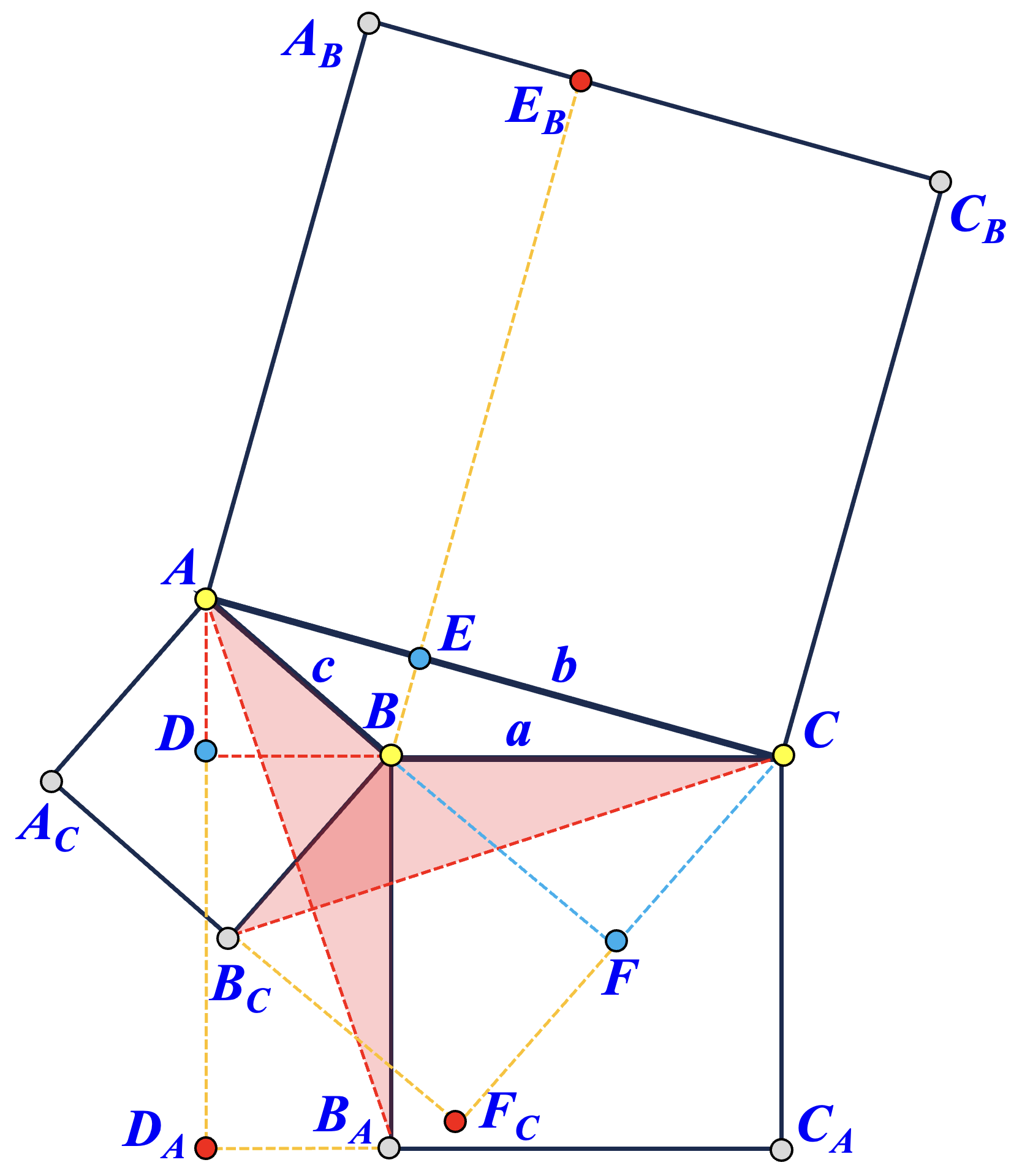 The Scissors at \( B \)
|
 The Scissors at \( C \)
|
 The Scissors at \( A \)
|
Case (3): The Selected Angle Is Obtuse
If \( \angle A \) is obtuse,
it is the result of rotating Case (2) \( 180^{\circ} \)
and the reasoning is all the same.
For your conenience,
we provide a full proof here.
In this case, the perpendicular foot \( E \) from \( B \) to \( \overleftrightarrow{AC} \)
is outside of \( \overline{AC} \),
and the perpendicular foot \( F \) from \( C \) to \( \overleftrightarrow{AB} \)
is outside of \( \overline{AB} \).
The first diagram below shows that the scissors at \( B \) gives
\[ \mbox{Area}(BDD_AB_A) = 2\cdot\mbox{Area}(\bigtriangleup BAB_A)
=2\cdot\mbox{Area}(\bigtriangleup BCB_C) = \mbox{Area}(BFF_CB_C). \]
The scissors at \( C \) (the second diagram) shows
\[ \mbox{Area}(CDD_AC_A) = 2\cdot\mbox{Area}(\bigtriangleup CAC_A)
=2\cdot\mbox{Area}(\bigtriangleup CBC_B) = \mbox{Area}(CEE_BC_B). \]
Finally, the scissors at \( A \) (the right diagram) shows
\[ \mbox{Area}(AEE_BA_B) = 2\cdot\mbox{Area}(\bigtriangleup ABA_B)
=2\cdot\mbox{Area}(\bigtriangleup ACA_C) = \mbox{Area}(AFF_CA_C). \]
In this way, we have the following:
$$
\begin{eqnarray*}
a^2 &=& \overline{BC}^2 = \mbox{Area}(BCC_AB_A) = \mbox{Area}(CDD_AC_A)+\mbox{Area}(BDD_AB_A)\\
&=& \mbox{Area}(CEE_BC_B)+\mbox{Area}(BFF_CB_C) \\
&=& \left( \mbox{Area}(CAA_BC_B) + \mbox{Area}(AEE_BA_B)\right)
+ \left( \mbox{Area}(ABB_CA_C) + \mbox{Area}(AFF_CA_C) \right) \\
&=& \mbox{Area}(CAA_BC_B) + \mbox{Area}(ABB_CA_C) +
\left( \mbox{Area}(AEE_BA_B) + \mbox{Area}(AFF_CA_C) \right) \\
&=& b^2 + c^2 +2\cdot\mbox{Area}(AEE_BA_B) = b^2 + c^2 + 2b\cdot\overline{AE} \\
&\mbox{or}& b^2 + c^2 + 2\cdot\mbox{Area}(AFF_CA_C) = b^2 + c^2 + 2c\cdot\overline{AF}
\end{eqnarray*}
$$
Note that this proves II.12 (obtuse angle)
and the previous two cases jointly prove II.13 (acute angle).
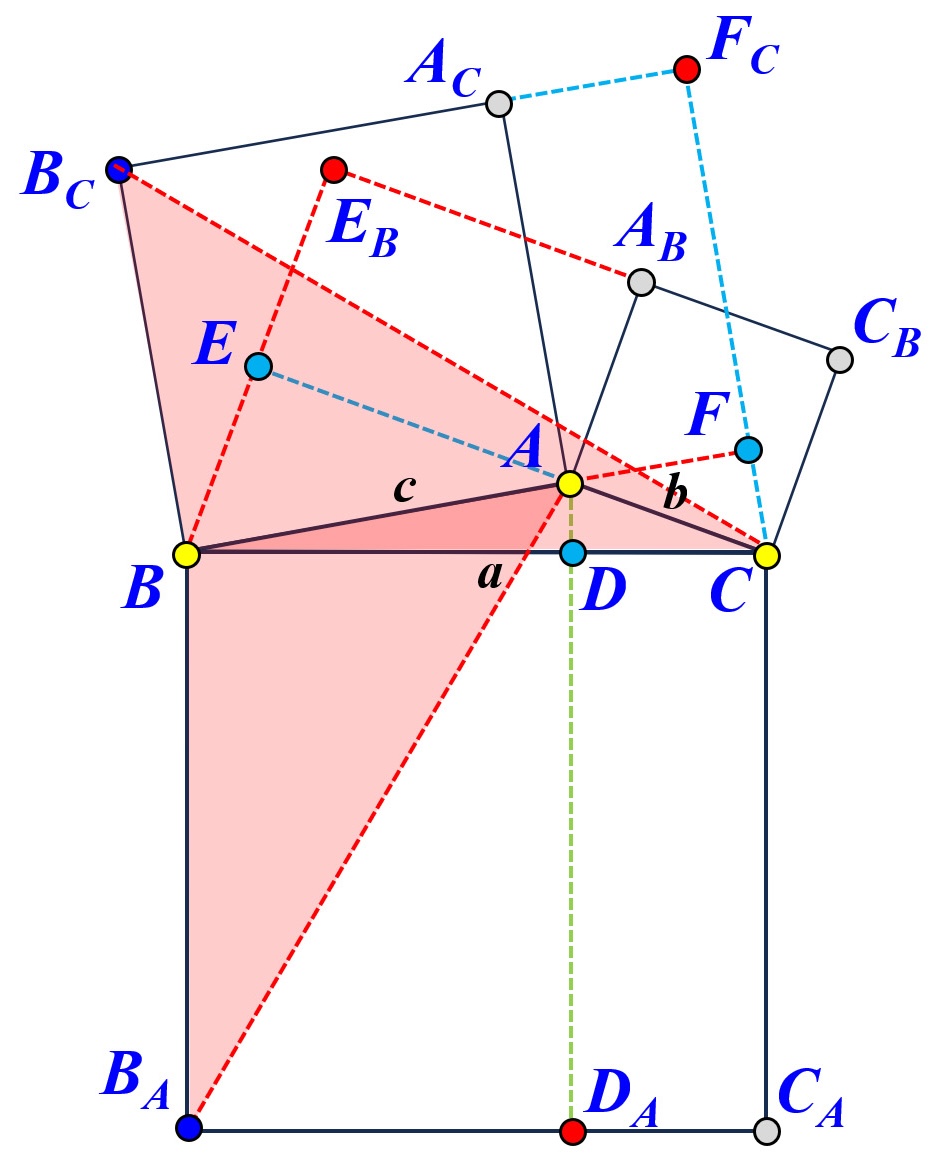 The Scissors at \( B \)
|
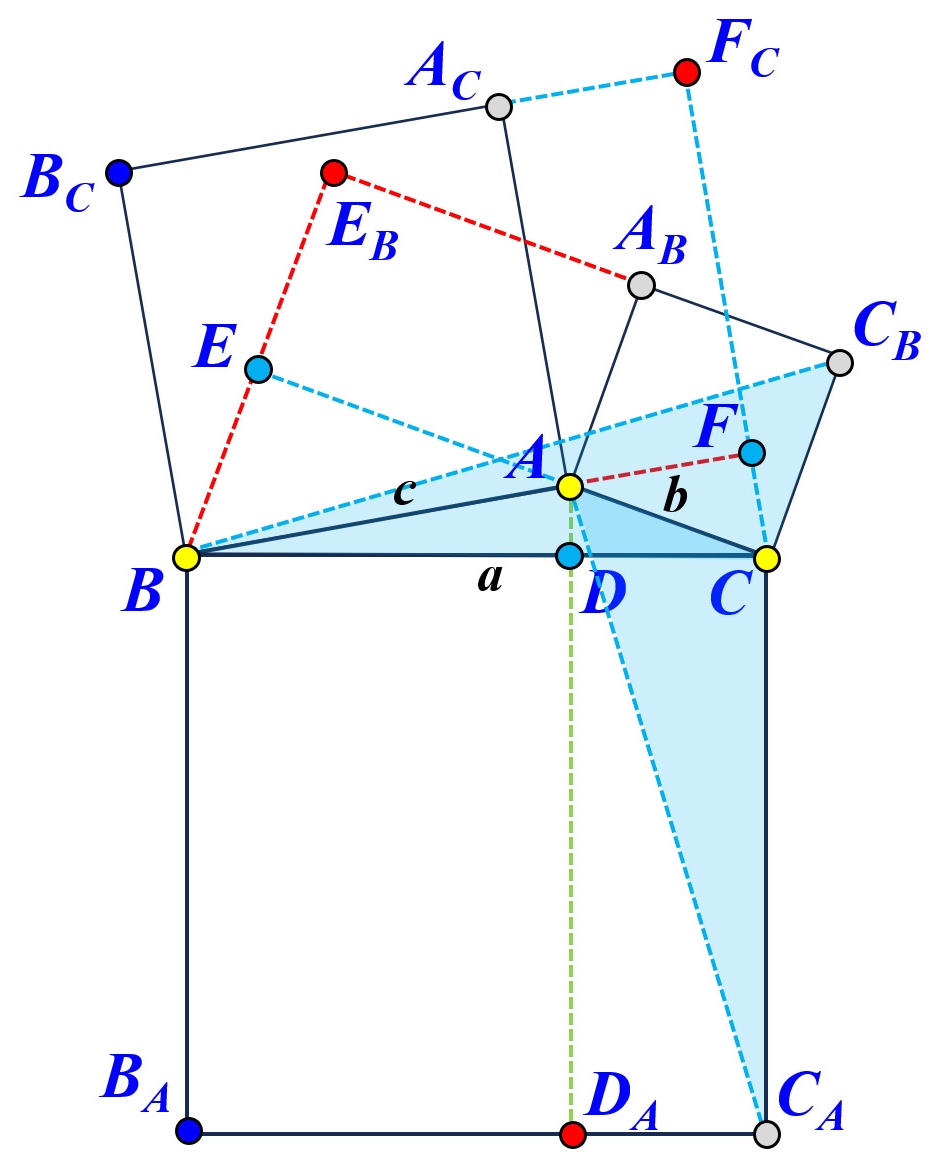 The Scissors at \( C \)
|
 The Scissors at \( A\)
|
Consequently, we proved II.12 and II.13 using Euclid's Scissors
without using the Pythagorean Theorem.
Go back to
Home Page.