Elements: Book II Propositions 12 and 13 (II.12 and II.13)
the Original Proofs
Ching-Kuang Shene (冼鏡光), Professor Emeritus
Department of Computer Science
Michigan Technological University
Houghton, MI 49931
USA
Created March 19, 2026

Book II of Elements has two propositions,
Proposition 12 and Proposition 13, dealing with the non-right-angled case.
Proposition 12 is for obtuse angle and Proposition 13 is for acute angle.
In Heath's translation,
the acute angle case goes as follows:
In acute-angled triangles the square on the side subtending the acute angle is less
than the squares on the sides containing the acute angle by twice the rectangle
contained by one of the sides about the acute angle, namely that on which the perpendicular
falls, and the straight line cut off within by the perpendicular towards
the acute angle (p. 406).
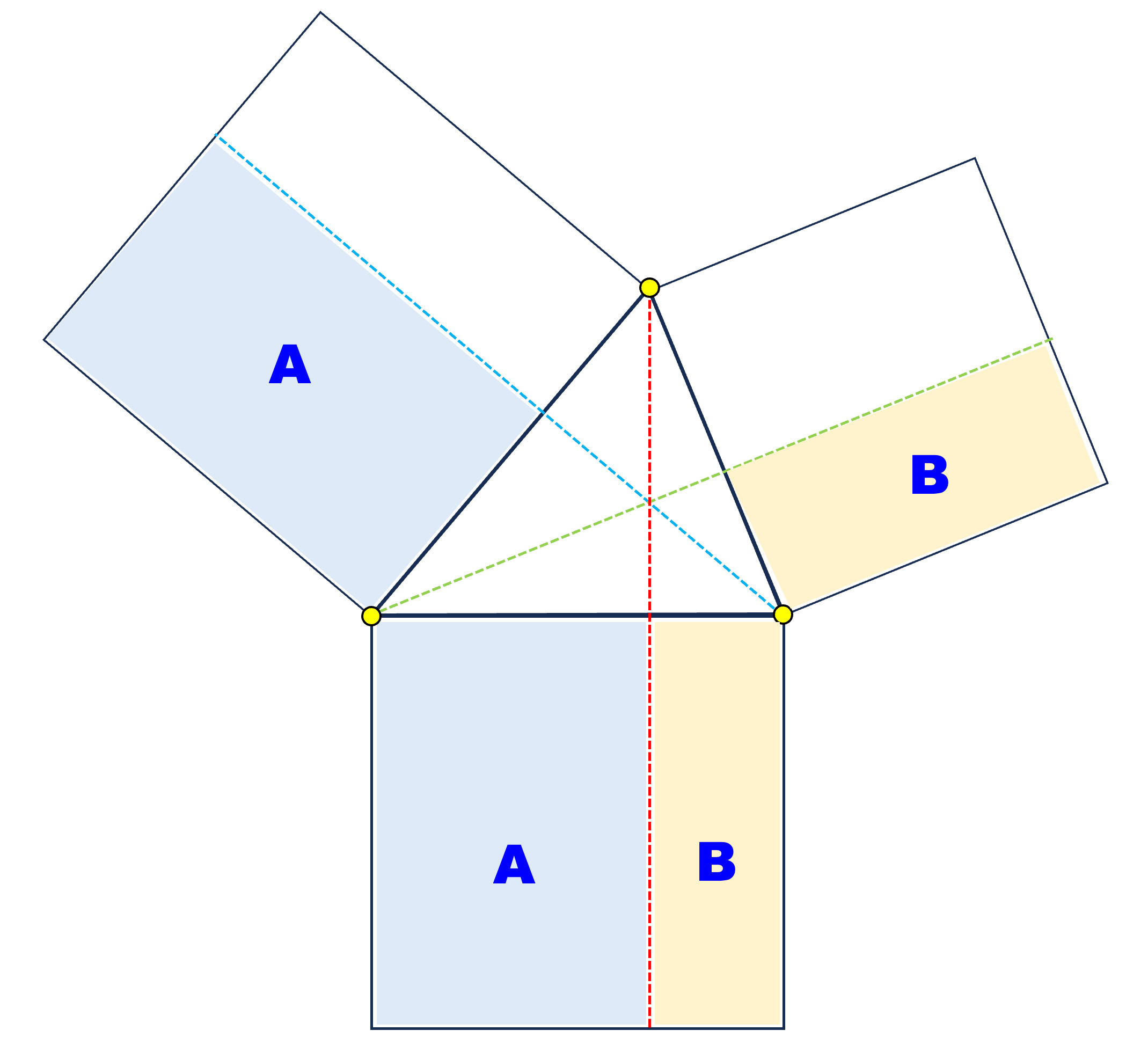
The left diagram below shows the acute angle case.
The top vertex has an acute angle
and its vertex is adjacent to two sides.
From each of the other two vertices,
a perpendicular to its opposite side cuts the square on that side into two rectangles.
Proposition 13 states that the square on the opposite side of the selected vertex
is smaller than the sum of the squares on the two adjacent sides.
The difference is twice of the rectangle determined by an adjacent side and the
the length from the selected vertex to the perpendicular foot on that adjacent side.
 The Acute Angle Case
|
 The Obtuse Angle Case
|
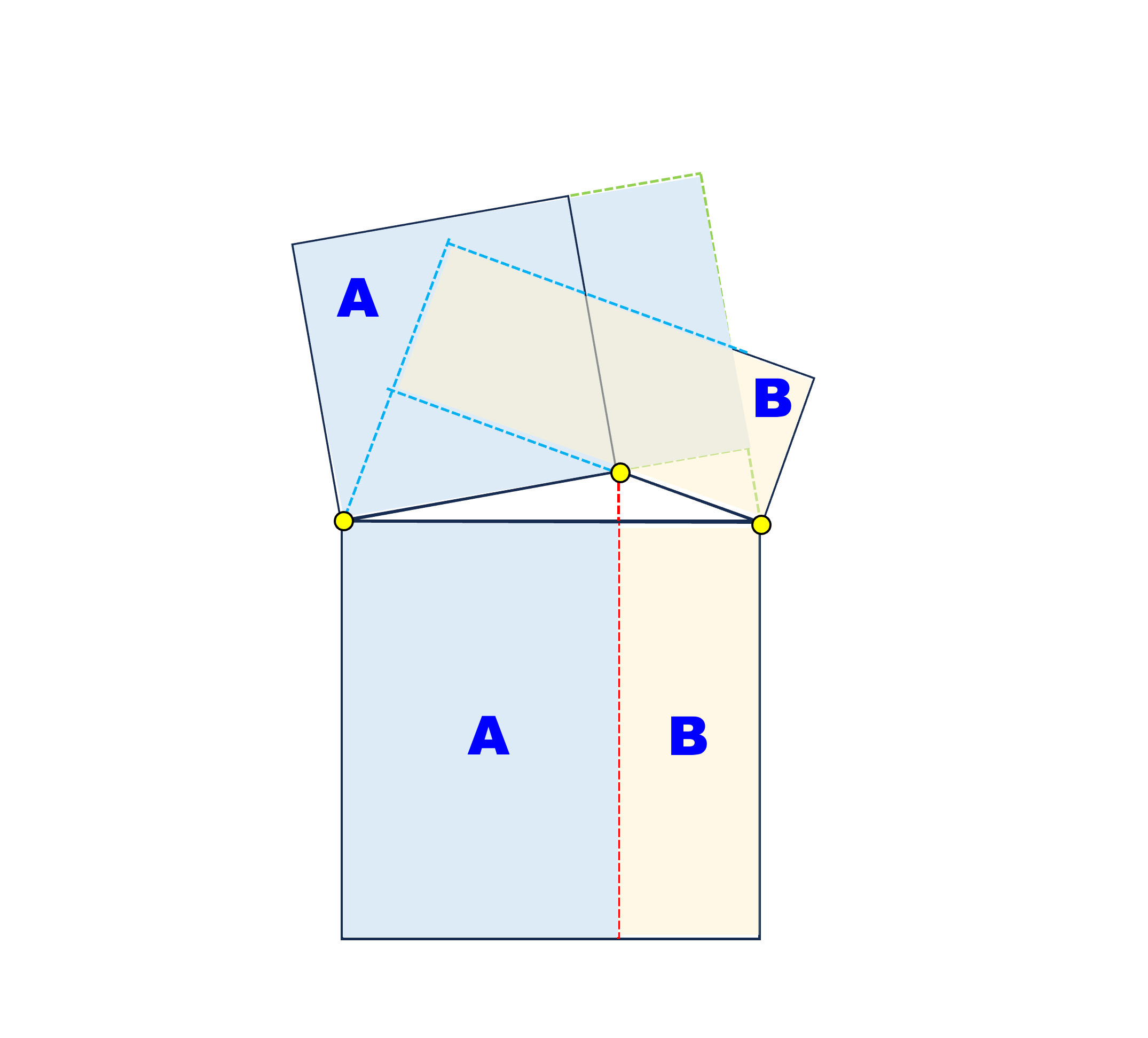
On the other hand, if the selected vertex has an obtuse angle,
the square on the opposite side of the selected vertex
is larger than the sum of the squares on the two adjacent sides.
The difference is twice of the rectangle determined by an adjacent side and
the length from the selected vertex to the perpendicular foot on that adjacent side.
Note that the perpendicular feet are not within the side.
In Euclid's era, trigonometry was not available.
As a result, Proposition 12 and Proposition 13 stated the results
using lengths and areas.
Before proving II.12 and II.13,
Elements proved two simple
results about areas.
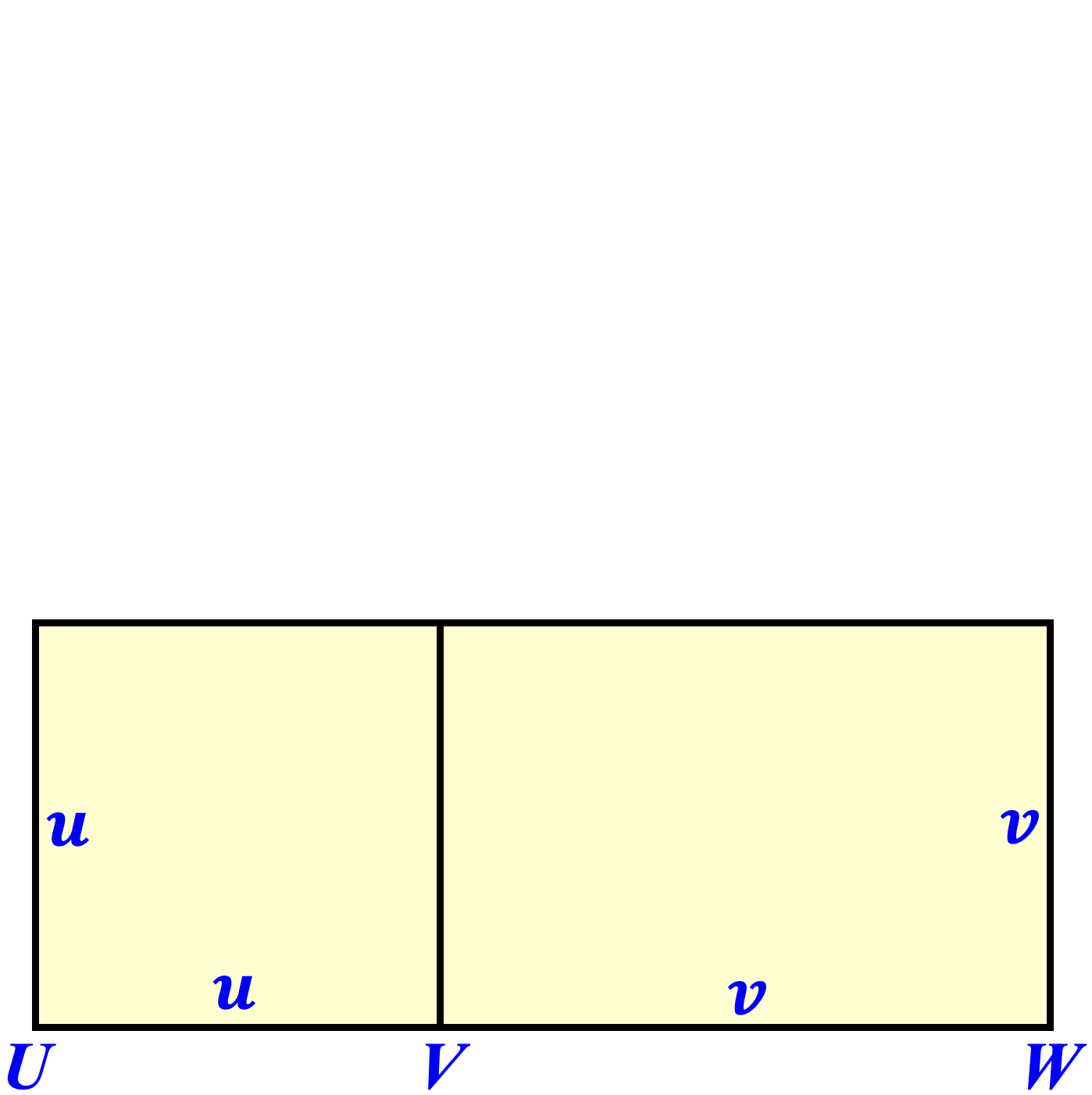
The first result, states that if \( V \) is a point on \( \overline{UW} \)
then the sum of area of the square on \( \overline{UV} \)
and the area of the rectangle formed by sides \( \overline{UV} \)
and \( \overline{VW} \)
is equal to the area of the rectangle formed by \( \overline{UV} \)
and \( \overline{UW} \).
See the left diagram below.
If we use \( u = \overline{UV} \) and \( v = \overline{VW} \),
this is exactly \( (u+v)u = u^2 + u\cdot v \).
 \( (u+v)v = u^2 + u\cdot v \)
|
 \( (u+v)^2=u^2 + v^2 + 2u\cdot v \)
|
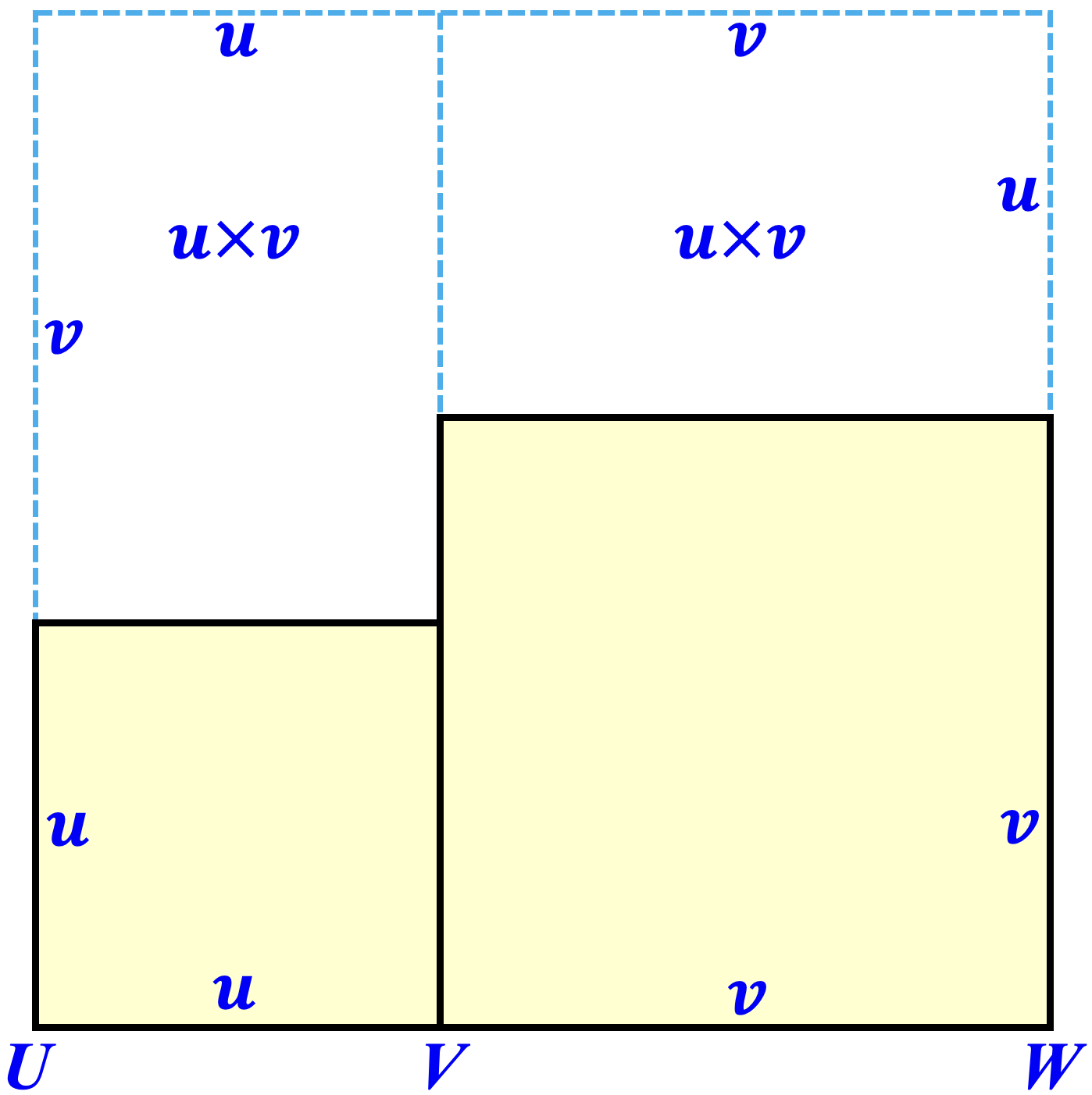
The second states that the sum of the area of the square on \( \overline{UW} \)
is the sum of the area of the square on \( \overline{UV} \),
the area of the square on \( \overline{VW} \)
and twice of the area of the rectangle formed by \( \overline{UV} \)
and \( \overline{VW} \).
See the right diagram above.
This is equivalent to \( (u+v)^2=u^2 + v^2 + 2u\cdot v \).
The proofs in Elements
uses the Pythagorean Theorem I.47.
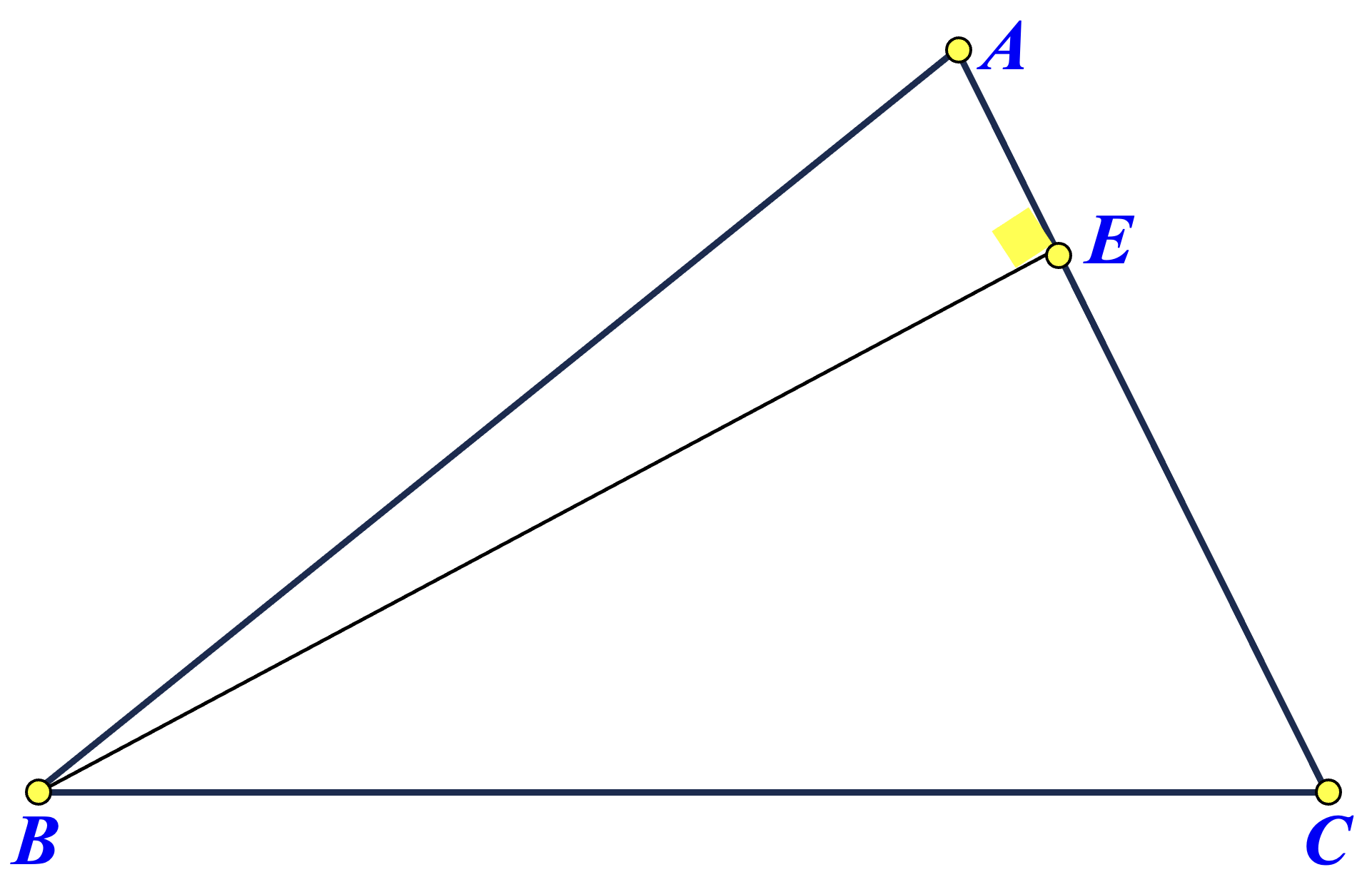
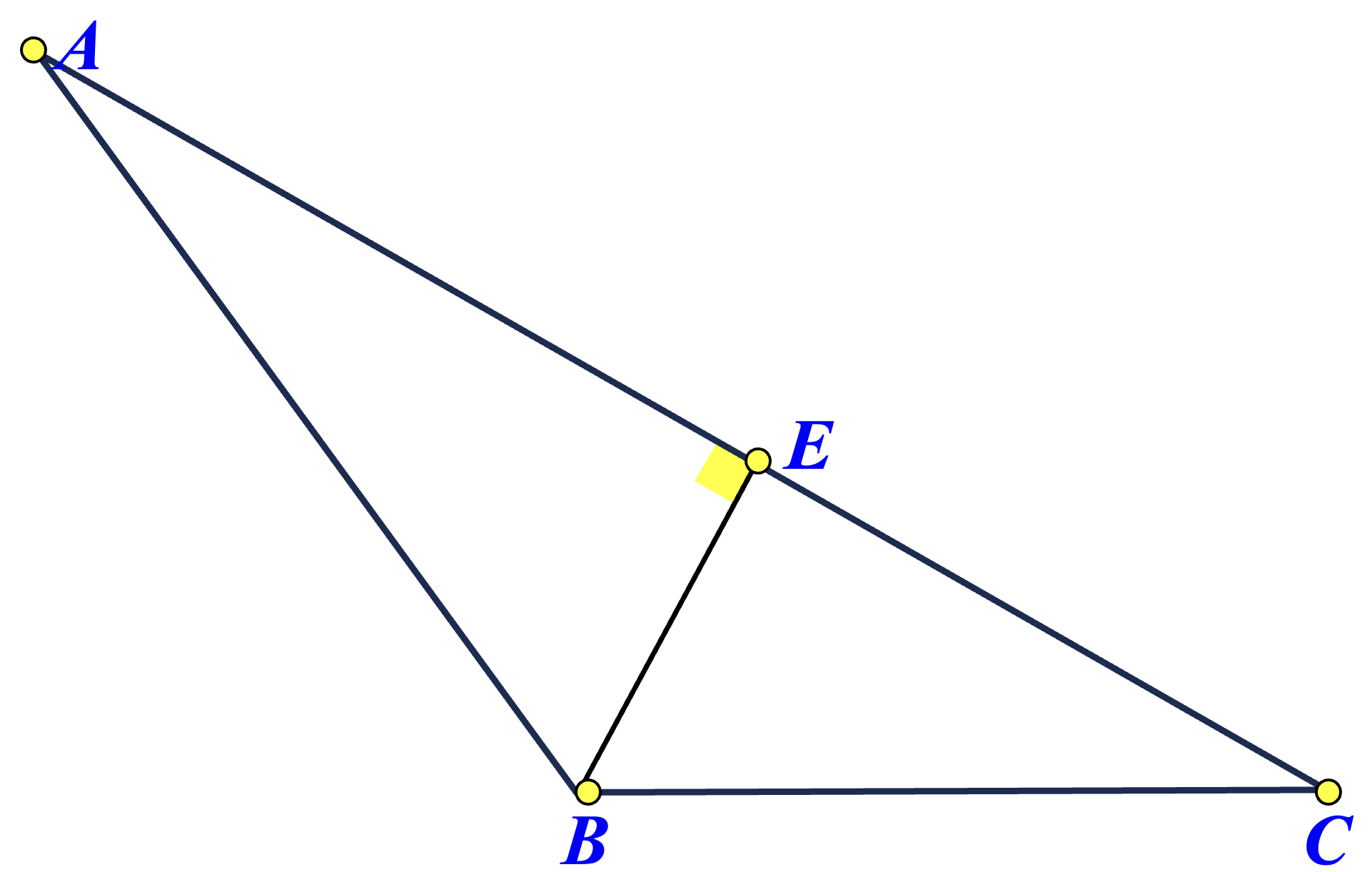
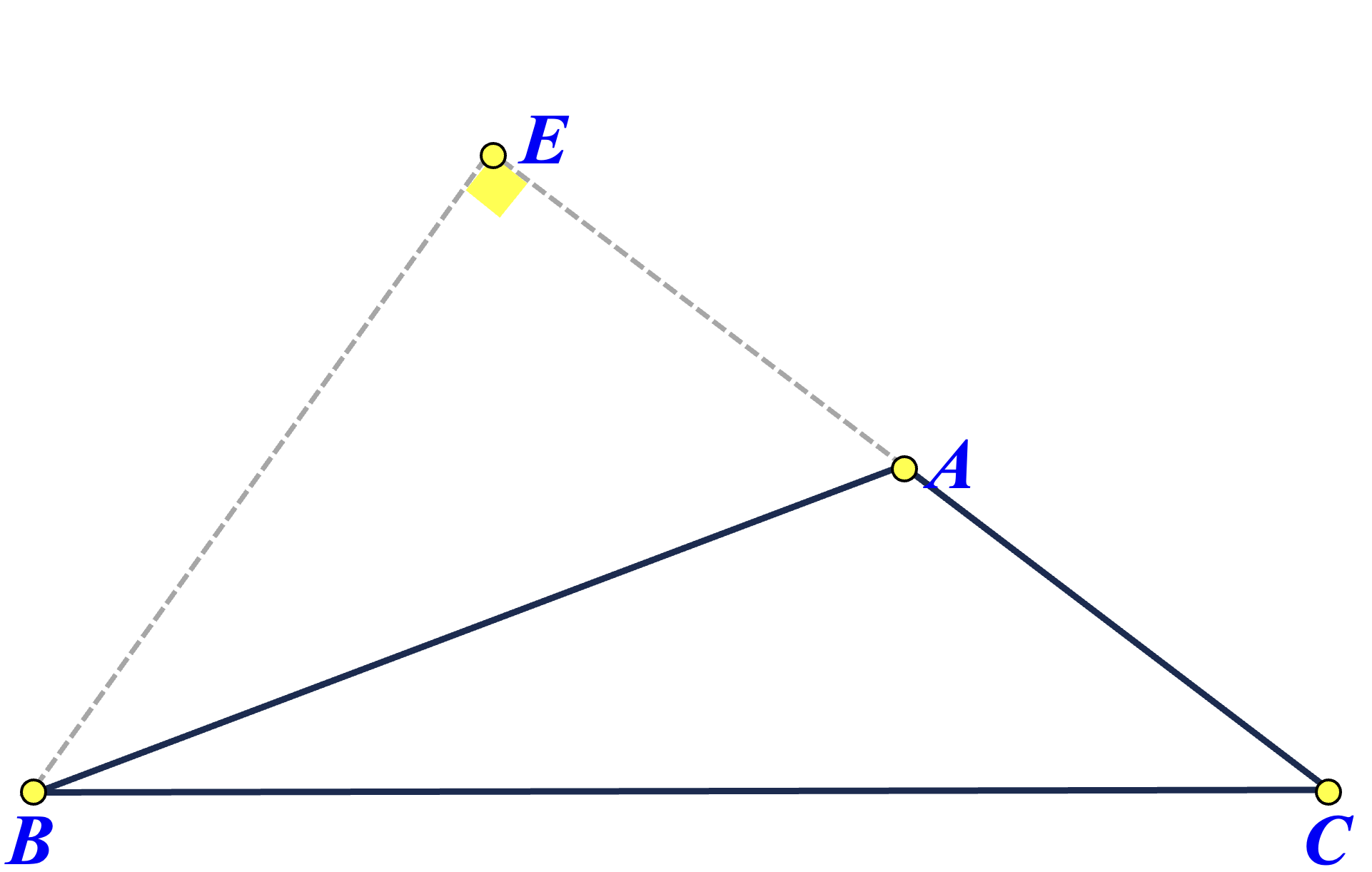
Given a triangle \( \bigtriangleup ABC \),
let \( A \) is the selected vertex.
We have three cases to consider:
(1) all angles being acute;
(2) an obtuse angle, but not
the selected one;
and
(3) the chosen vertex being an obtuse angle.
From \( B \) drop a perpendicular to the opposite side \( \overleftrightarrow{AC} \),
meeting it at \( E \).
Note that if the angle at \( A \) is acute, \( E \) lies between \( A \) and \( C \).
Otherwise, \( E \) lies outside of \( \overline{AC} \).
 All Acute Angles
|
 The Chosen Vertex Is Acute
|
 The Chosen Vertex Is Obtuse
|
Consider Case (1) and Case (2) first.
The angle at the selected vertex \( A \) is acute.
By the Pythagorean Theorem, we have
\[ \overline{AB}^2 = \overline{AE}^2 + \overline{BE}^2
\quad\mbox{and}\quad
\overline{BC}^2 = \overline{BE}^2 + \overline{CE}^2 \]
Then, with the help of the second result above, we obtain the following:
$$
\begin{eqnarray*}
\overline{AB}^2 + \overline{AC}^2
&=& \left( \overline{AE}^2 + \overline{BE}^2 \right)
+ \left( \overline{AE}^2+\overline{EC}^2+2\overline{AE}\cdot\overline{EC}\right)\\
&=& \left( \overline{BE}^2 + \overline{EC}^2\right)
+ 2\left( \overline{AE}^2 + \overline{AE}\cdot\overline{EC} \right) \\
&=& \overline{BC}^2 + 2\overline{AE}\cdot
\left( \overline{AE} + \overline{EC}\right) \\
&=& \overline{BC}^2 + 2\overline{AE}\cdot\overline{AC}
\end{eqnarray*}
$$
As for Case (3), \( E \) is outside of \( \overline{AC} \).
We have \( \overline{EC}^2 = \overline{EA}^2 + \overline{AC}^2
+ 2\overline{AE}\cdot\overline{AC} \).
Then, the following holds:
$$
\begin{eqnarray*}
\overline{AB}^2 + \overline{AC}^2
&=& \left( \overline{AE}^2 + \overline{BE}^2 \right)
+ \left( \overline{EC}^2-\overline{EA}^2-2\overline{AE}\cdot\overline{AC}\right)\\
&=& \left( \overline{BE}^2 + \overline{EC}^2\right)
- 2\left( \overline{AE}\cdot \overline{AC} \right) \\
&=& \overline{BC}^2 - 2\overline{AE}\cdot\overline{AC}
\end{eqnarray*}
$$
Consequently, we proved II.12 and II.13.
It is very important to know that
the use of the Pythagorean Theorem is not necessary.
On the next page, we shall prove the same using the
Euclid's Scissors,
which is independent of the Pythagorean Theorem.
Go back to
Home Page.