Elements: Book II Propositions 12 and 13 (II.12 and II.13)
the Law of Cosines
Ching-Kuang Shene (冼鏡光), Professor Emeritus
Department of Computer Science
Michigan Technological University
Houghton, MI 49931
USA
Created March 23, 2026
Modified April 4, 2026

After proving II.12 and II.13,
it is easy to show that they jointly established the Law of Cosines.
Note that in Euclid's era, trigonometry was not available
and in Elements
II.12 and II.13 are stated using areas.
The Euclid's Scissors page proved
II.12 and II.13 using Euclid's Scissors.
Note that these two proofs did not use the Pythagorean Theorem nor the Pythagoren Identity.
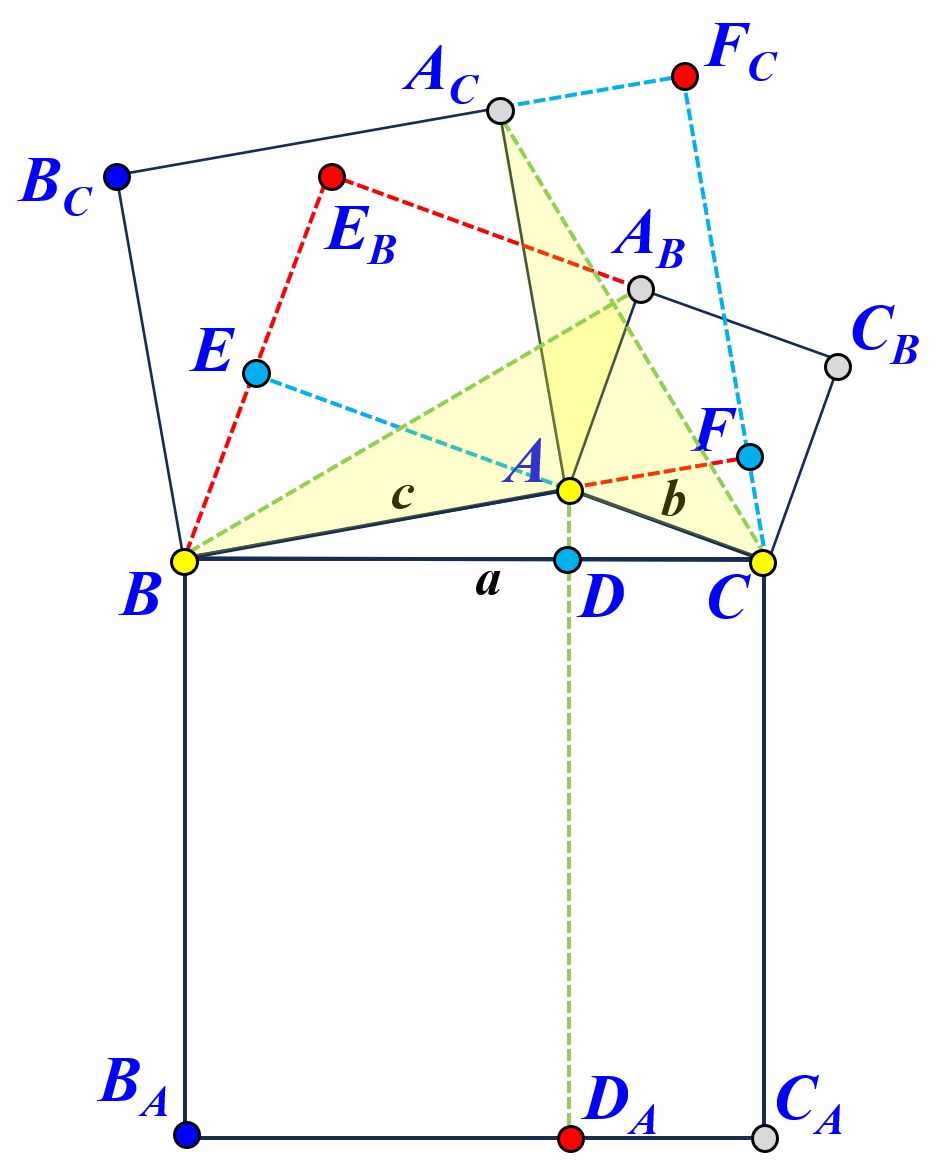
There are two cases depending on whether \( A=\alpha \) is acute or obtuse.
If all angles are acute, we have the following:
$$
\begin{eqnarray*}
a^2 &=& b^2 + c^2 - 2\cdot\mbox{Area}(AFF_CA_C) = b^2 + c^2 - 2c\cdot\overline{AF} \\
&\mbox{or}& b^2 + c^2 - 2\cdot\mbox{Area}(AFF_CA_C) = b^2 + c^2 - 2b\cdot\overline{AE}.
\end{eqnarray*}
$$
From \( \bigtriangleup ABE \) we have
\( \overline{AE} = \overline{AB}\cdot \cos(\alpha) = c\cdot\cos(\alpha) \).
From right triangle \( \bigtriangleup ACF \) we have
\( \overline{AF} = \overline{AC}\cdot \cos(\alpha) = b\cdot\cos(\alpha)\).
In both cases, we have \( a^2=b^2+c^2 -2b\cdot c\cdot\cos(\alpha) \)
and this is the Law of Cosines.
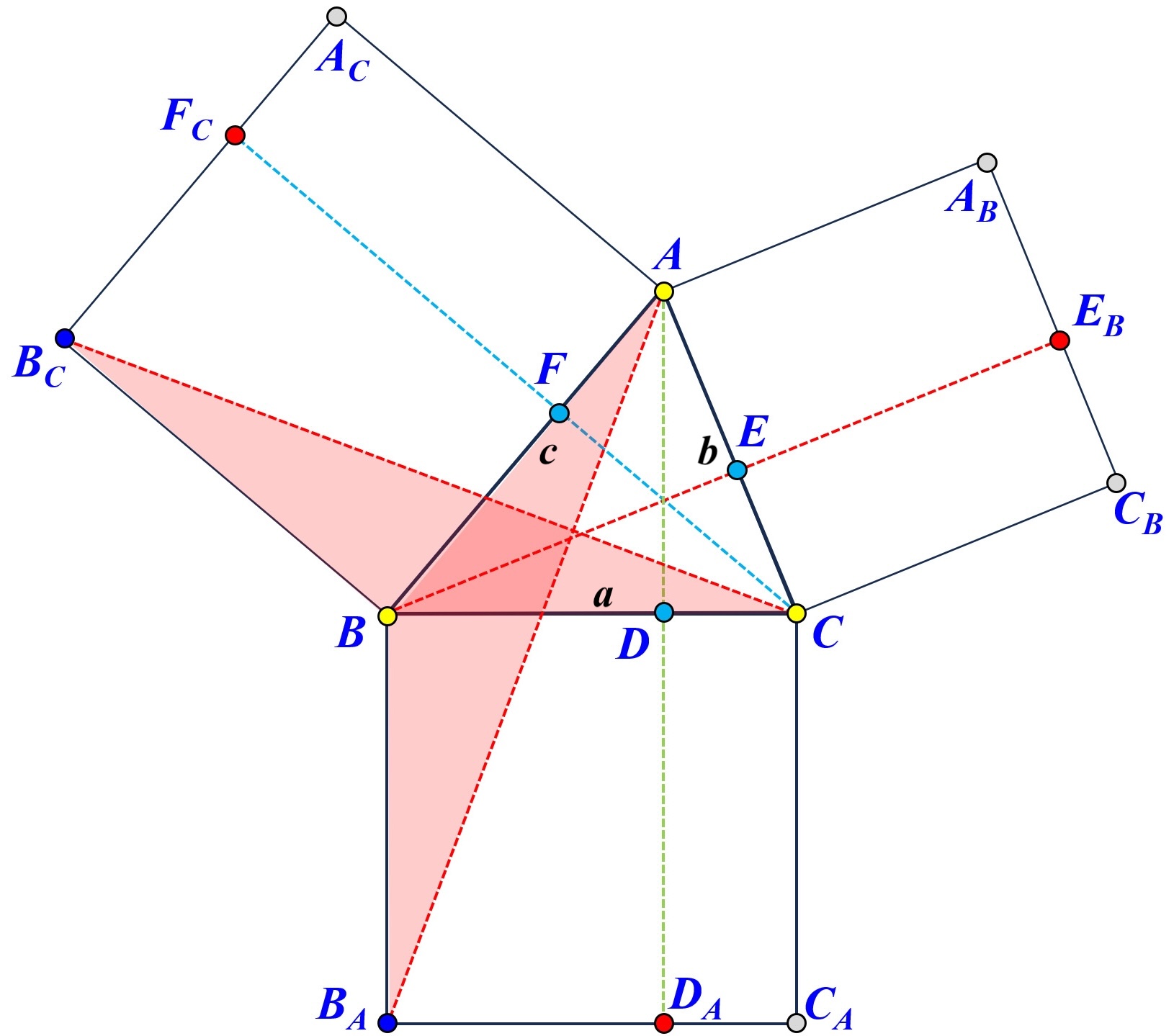 The Scissors at \( B \)
|
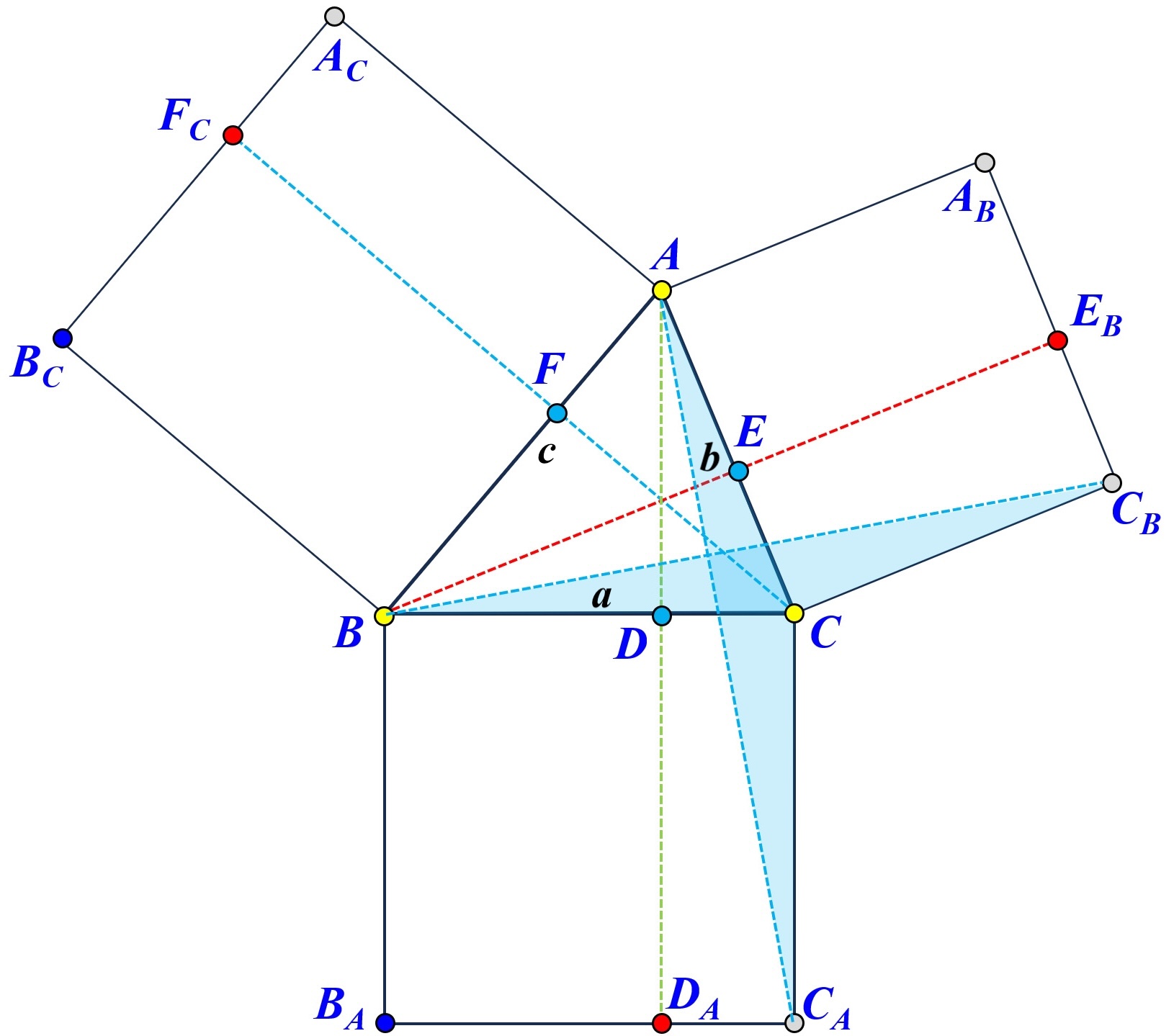 The Scissors at \( C \)
|
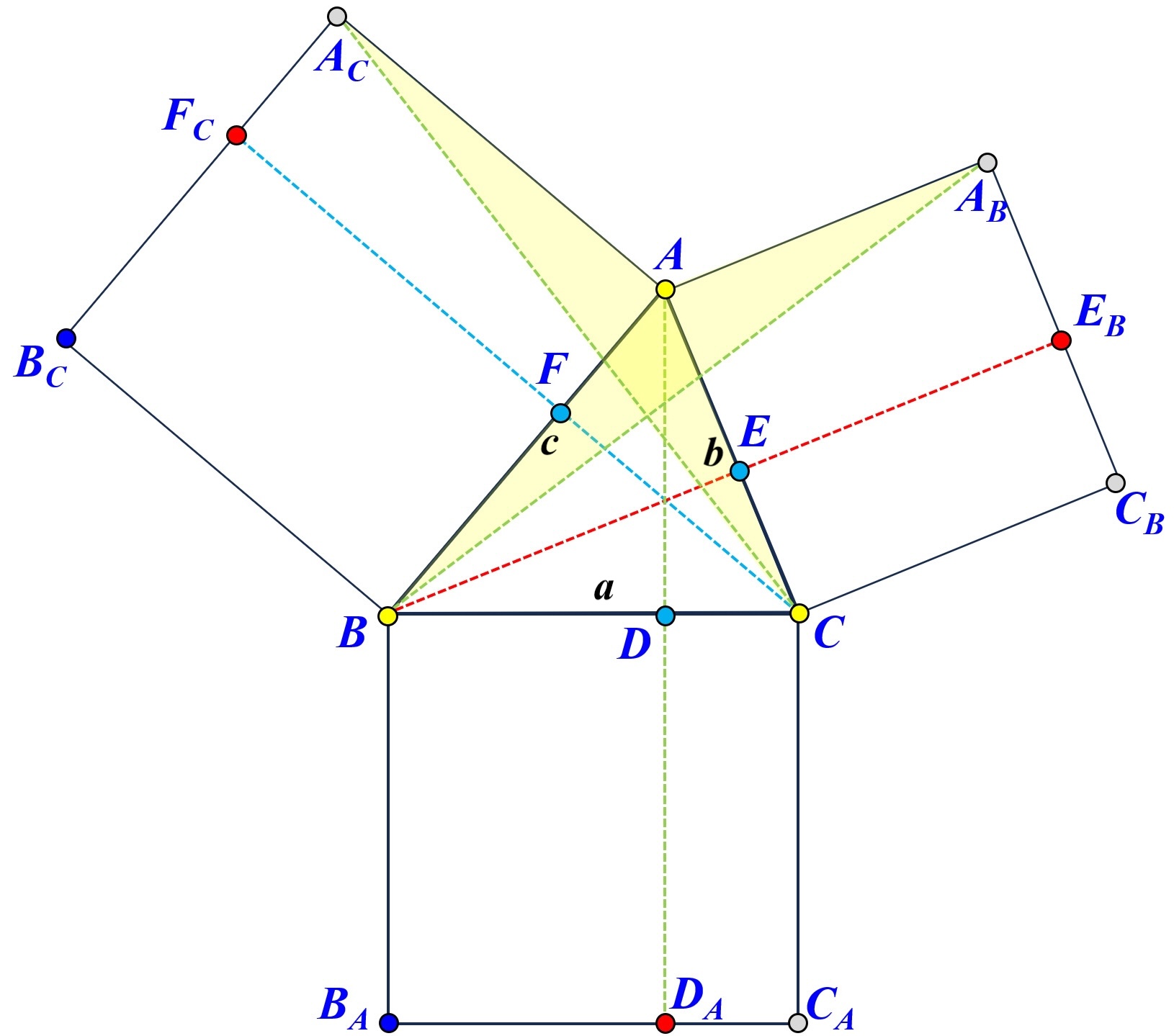 The Scissors at \( A \)
|
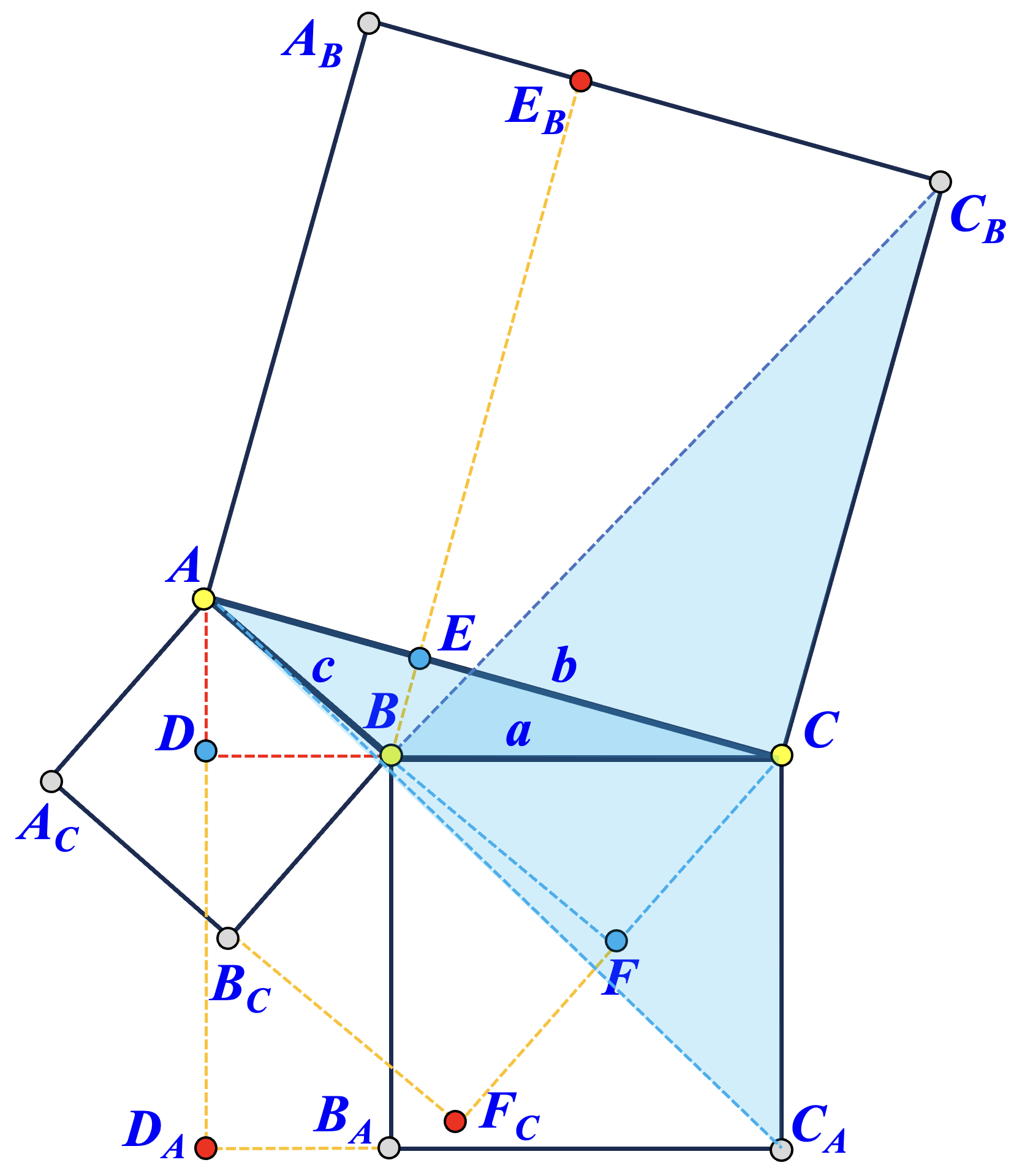
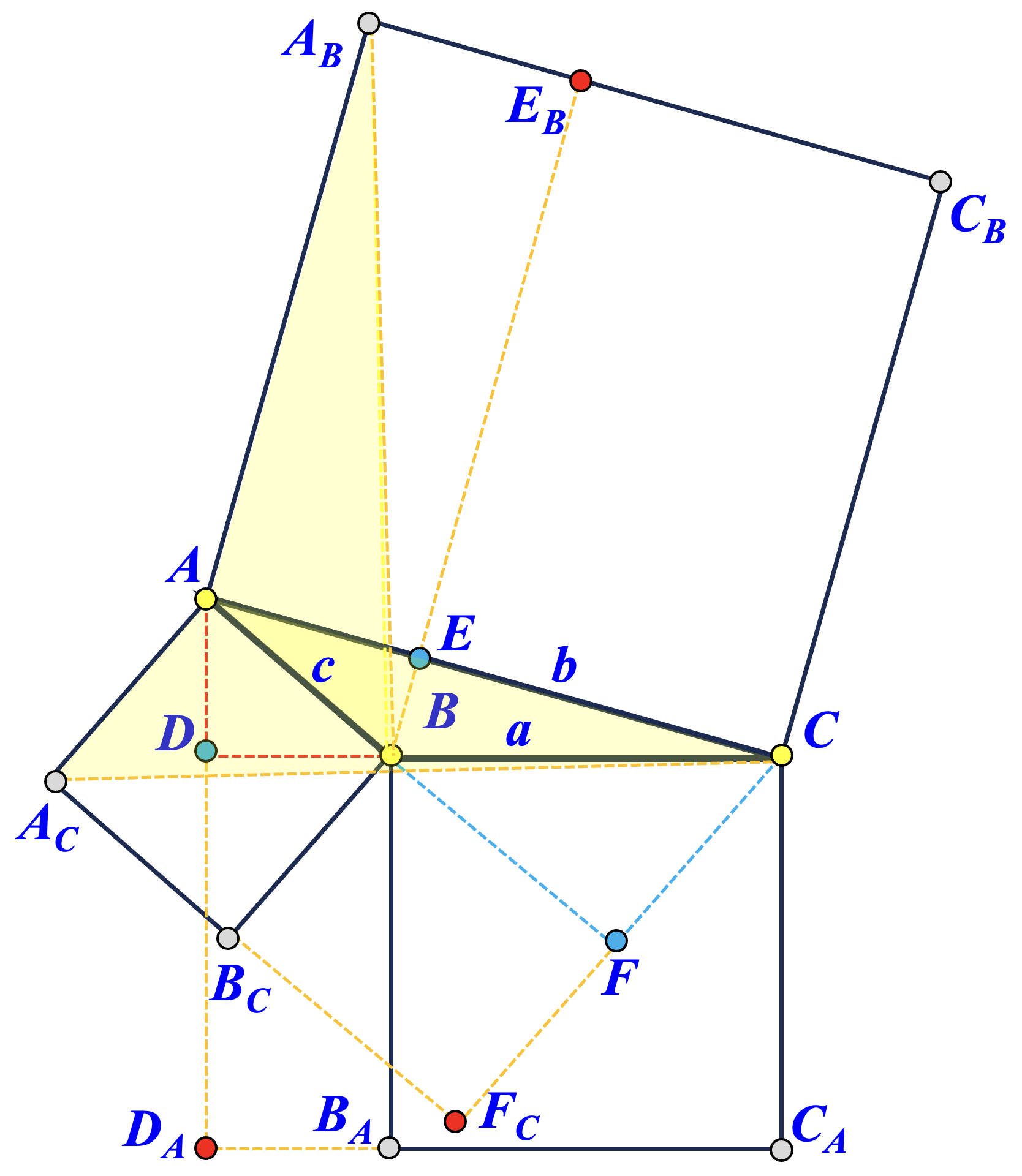
If \( \alpha \) is acute but there is an obtuse angle in \( \bigtriangleup ABC \), say \( \beta \),
\( D \) and \( F \) are outside of the triangle.
As shown before, we still have the following:
$$
\begin{eqnarray*}
a^2 &=& b^2 + c^2 - 2\cdot\mbox{Area}(AFF_CA_C) = b^2 + c^2 - 2c\cdot\overline{AF} \\
&\mbox{or}& b^2 + c^2 - 2\cdot\mbox{Area}(AFF_CA_C) = b^2 + c^2 - 2b\cdot\overline{AE}.
\end{eqnarray*}
$$
From \( \bigtriangleup ABE \) we have \( \overline{AE}= c\cdot\cos(\alpha) \)
and
from \( \bigtriangleup ACF \) we have \( \overline{AF}= b\cdot\cos(\alpha) \).
Therefore, the Law of Cosines in this case holds.
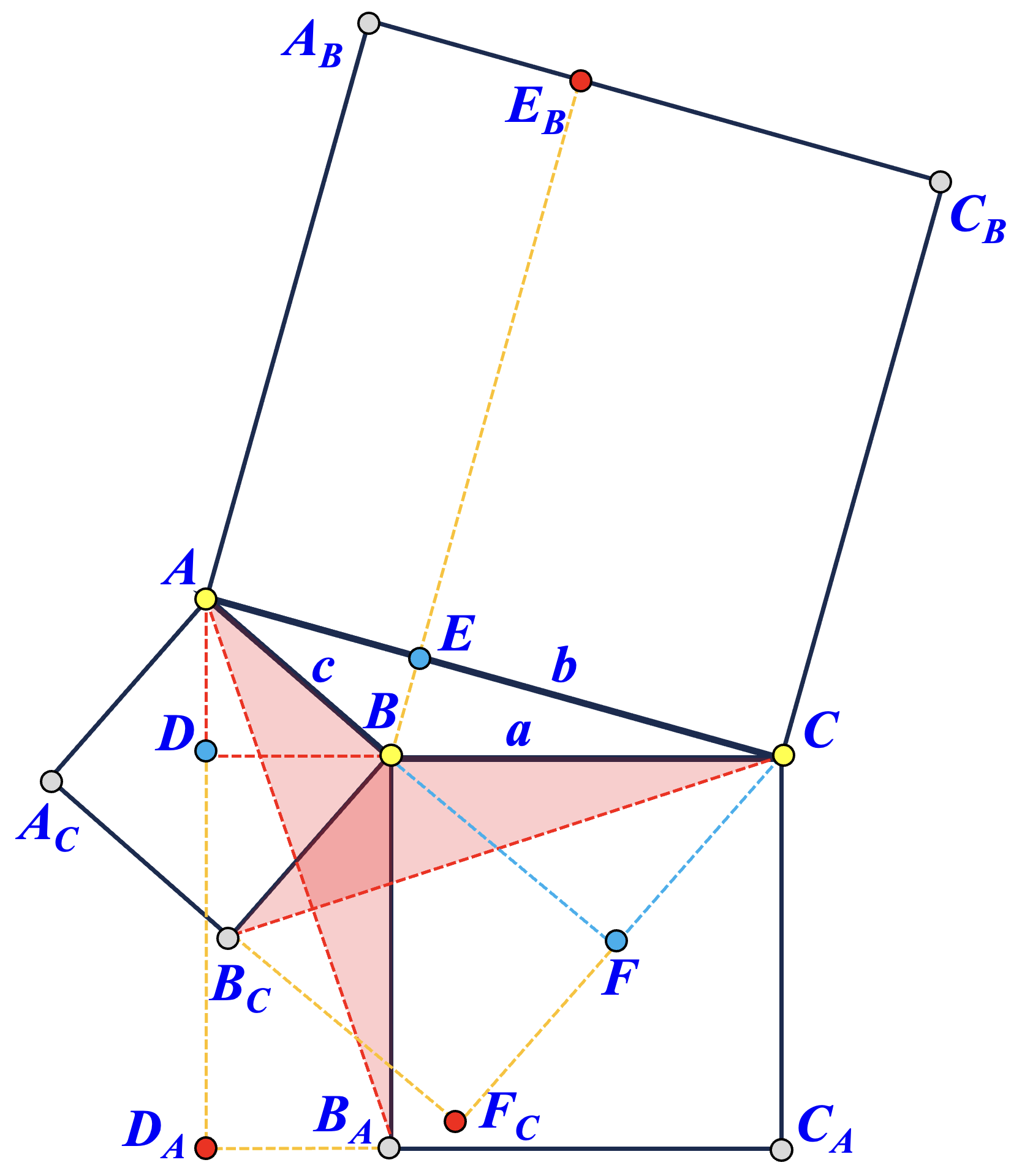 The Scissors at \( B \)
|
 The Scissors at \( C \)
|
 The Scissors at \( A \)
|
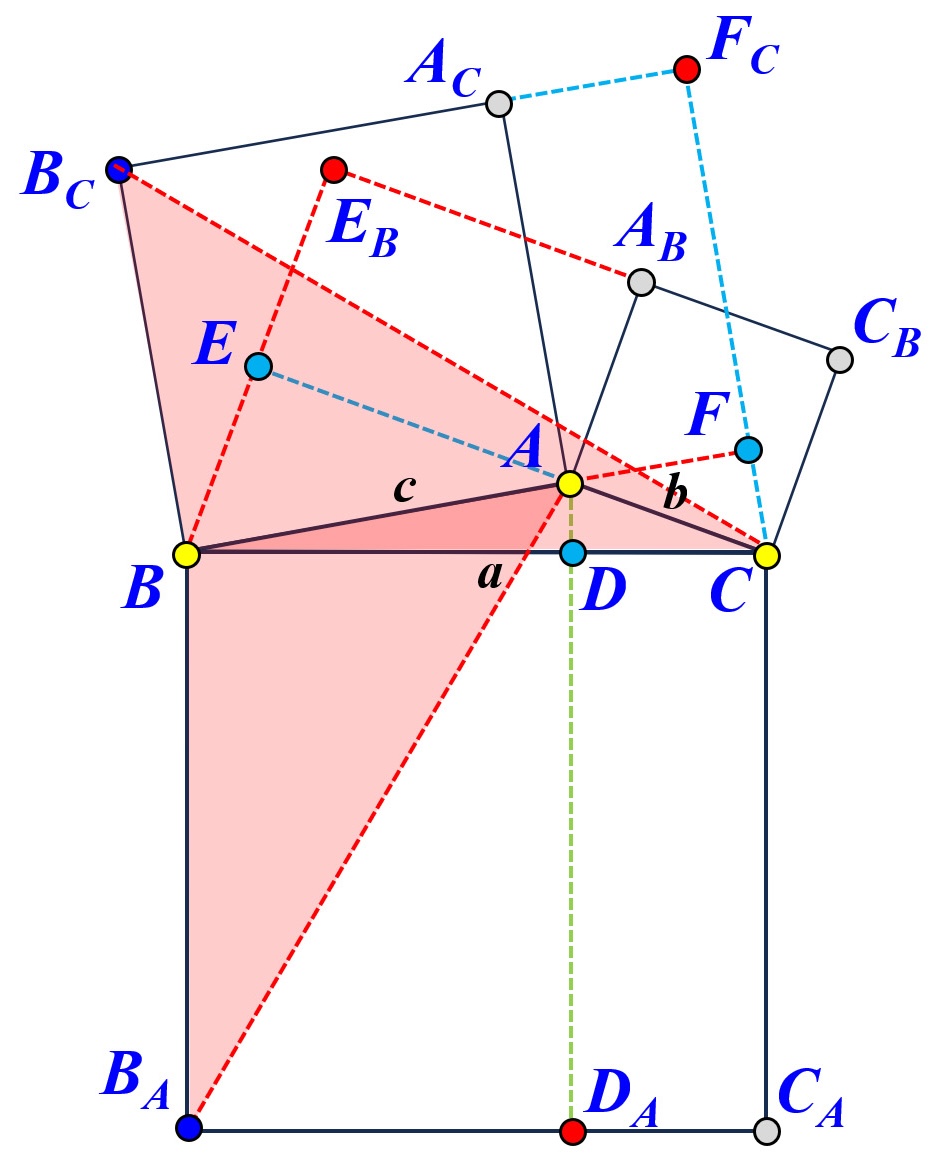
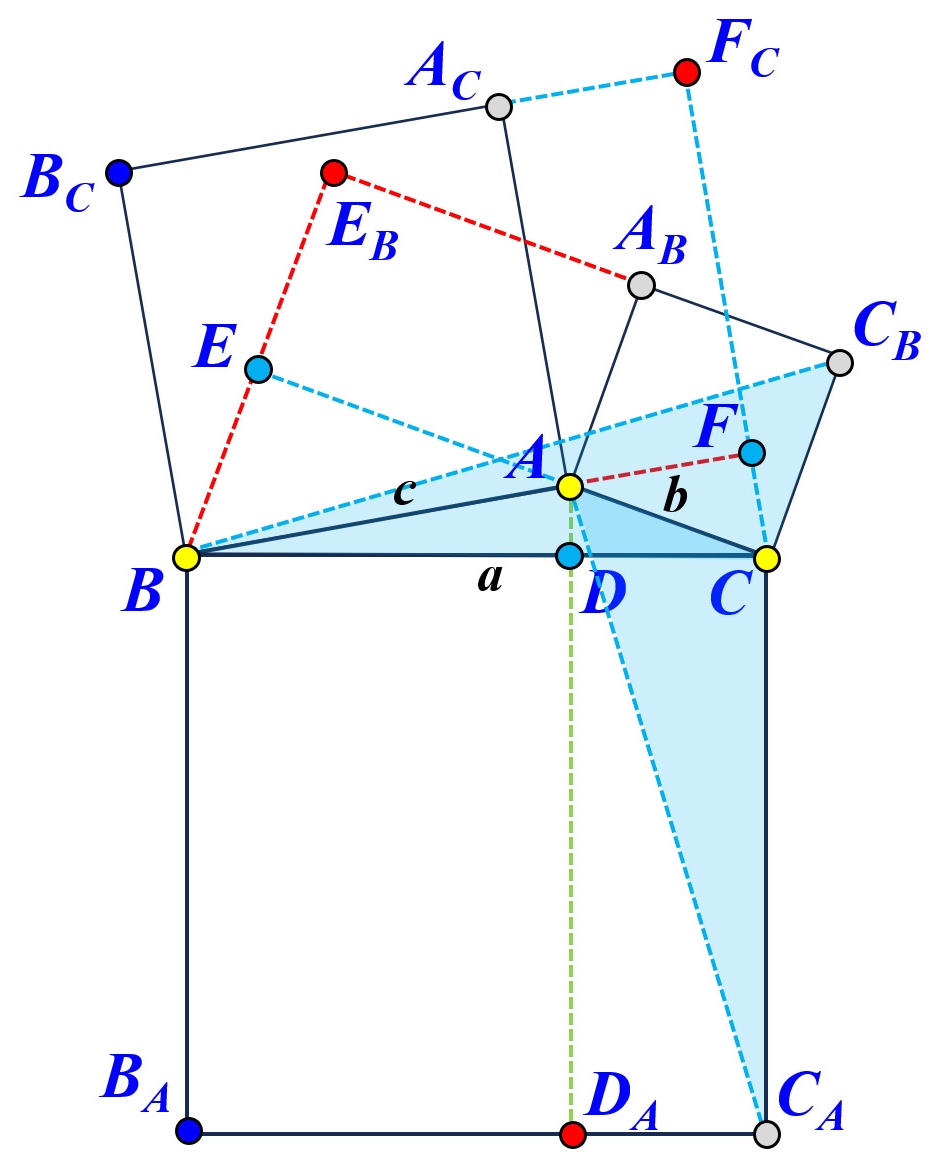
If \( A \) is obtuse, the minus sign becomes a plus:
$$
\begin{eqnarray*}
a^2 &=& b^2 + c^2 + 2\cdot\mbox{Area}(AEE_BA_B) = b^2 + c^2 + 2b\cdot\overline{AE} \\
&\mbox{or}& b^2 + c^2 + 2\cdot\mbox{Area}(AFF_CA_C) = b^2 + c^2 + 2c\cdot\overline{AF}.
\end{eqnarray*}
$$
 The Scissors at \( B \)
|
 The Scissors at \( C \)
|
 The Scissors at \( A\)
|
In this case \( E \) and \( F \) are outside of \( \bigtriangleup ABC \).
As a result, \( \overline{AE} = c\cdot\cos(\angle BAE)=c\cdot\cos(180^{\circ}-\alpha)=-c\cdot\cos(\alpha) \).
Similarly, we have
\( \overline{AF} = b\cdot\cos(\angle CAF)=b\cdot\cos(180^{\circ}-\alpha)=-b\cdot\cos(\alpha) \).
Again, we proved the case of \( \alpha \) being obtuse.
In this way, we proved the Law of Cosines without using the Pythagorean Theorem
and the Pythagorean Identity.
Go back to
Home Page.