Proving the Pythagorean Theorem via Mollweide's Formulas
Ching-Kuang Shene (冼鏡光), Professor Emeritus
Department of Computer Science
Michigan Technological University
Houghton, MI 49931
USA
Created March 18, 2026

Ching-Kuang Shene (冼鏡光), Professor Emeritus
Department of Computer Science
Michigan Technological University
Houghton, MI 49931
USA
Created March 18, 2026
An Algebraic Proof
We shall prove the Pythagorean Theorem using Mollweide's Formulas.
Suppose \( \alpha = \angle A = 90^{\circ}\).
Then, \( \gamma = 90^{\circ}-\beta\).
We have the following:
$$
\begin{eqnarray*}
\frac{a-b}{c} &=& \frac{\sin\left( \frac{\alpha-\beta}{2}\right)}{\cos\left(\frac{\gamma}{2}\right)}
= \frac{\sin\left( \frac{90^{\circ}-\beta}{2}\right)}{\cos\left(\frac{\gamma}{2}\right)}
= \frac{\sin\left( \frac{\gamma}{2}\right)}{\cos\left(\frac{\gamma}{2}\right)}, \\
\frac{a+b}{c} &=& \frac{\cos\left( \frac{\alpha-\beta}{2}\right)}{\sin\left(\frac{\gamma}{2}\right)}
= \frac{\cos\left( \frac{90^{\circ}-\beta}{2}\right)}{\sin\left(\frac{\gamma}{2}\right)}
= \frac{\cos\left( \frac{\gamma}{2}\right)}{\sin\left(\frac{\gamma}{2}\right)}.
\end{eqnarray*}
$$
Multiplying the above two together gives
\[ \frac{a-b}{c}\cdot\frac{a+b}{c}
=\frac{\sin\left( \frac{\gamma}{2}\right)}{\cos\left(\frac{\gamma}{2}\right)} \cdot
\frac{\cos\left( \frac{\gamma}{2}\right)}{\sin\left(\frac{\gamma}{2}\right)} = 1. \]
As a result, we have \( a^2-b^2 = c^2\),
which implies \( a^2 = b^2 + c^2\).
Note that we proved Mollweide's Formulas without using the Pythagorean Theorem and the Pythagorean Identity. Therefore, the above proof does not have circular reasoning.
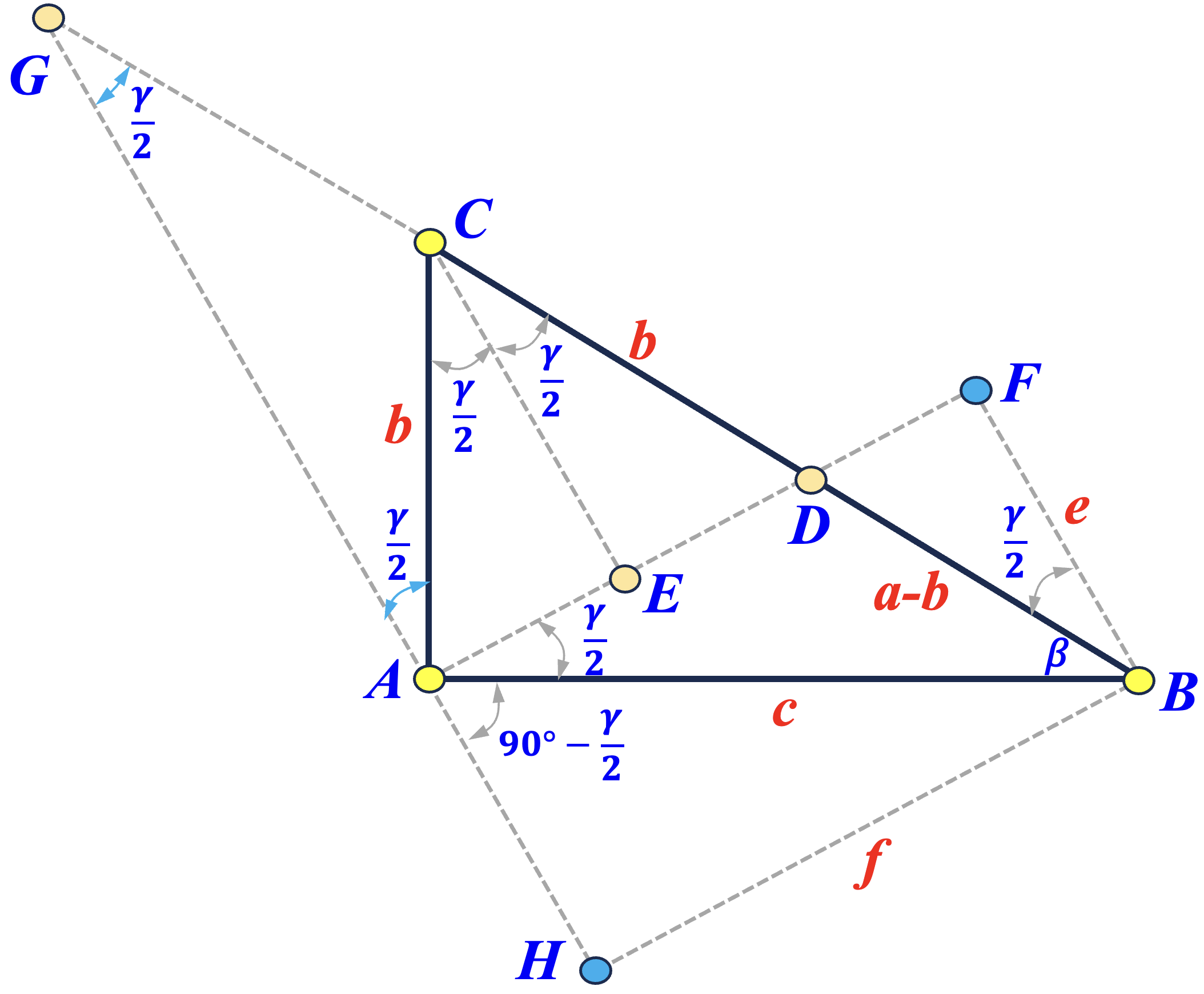
Given a right triangle \( \bigtriangleup ABC\) with \( \alpha=\angle A =90^{\circ}\), \( \beta=\angle B\), \( \gamma=\angle C\), \( a=\overline{BC}\), \( b= \overline{CA}\) and \( c=\overline{AB}\). Let \( D\) be the point on \( \overline{BC}\) such that \( \overline{CD}=\overline{CA}=b\). Hence, \( \overline{BD}=a-b\). Let \( E\) be the point on \( \overleftrightarrow{BC} \) such that it is not on \( \overline{BC}\) and \( \overline{CE} = b\). Hence, \( \overline{BE} = a+ b \). Let \( F\) and \( G \) be the perpendicular feet from \( B \) to \( \overleftrightarrow{AD} \) and \( \overleftrightarrow{AE} \), respectively. In this way, we have \[ \angle CAD=\angle CDA = \angle BDF = \angle BAG = 90^{\circ} - \frac{\gamma}{2} \quad\mbox{and}\quad \angle CAE =\angle CEA = \angle BAD = \angle DBF = \frac{\gamma}{2}. \] For convenience, let \( e = \overline{BF}\) and \( f=\overline{BF}\).
Following the idea shown on the geometric proof page here, we have $$ \begin{eqnarray*} (a-b)\cos\left( \frac{\gamma}{2} \right) &=& e = c\cdot\sin\left( \frac{\gamma}{2} \right) \\ (a+b)\sin\left( \frac{\gamma}{2} \right) &=& f = c\cdot\sin\left( 90^{\circ}-\frac{\gamma}{2} \right) = c\cdot\cos\left( \frac{\gamma}{2} \right). \end{eqnarray*} $$ The above gives the following results: \[ \frac{a-b}{c} = \frac{\sin\left( \frac{\gamma}{2} \right)}{\cos\left( \frac{\gamma}{2} \right)} \quad \mbox{and} \quad \frac{a+b}{c} = \frac{\cos\left( \frac{\gamma}{2} \right)}{\sin\left( \frac{\gamma}{2} \right)}. \] Therefore, we have \[ \frac{a-b}{c}\cdot\frac{a+b}{c} = 1 \] and hence the Pythagorean Theorem.
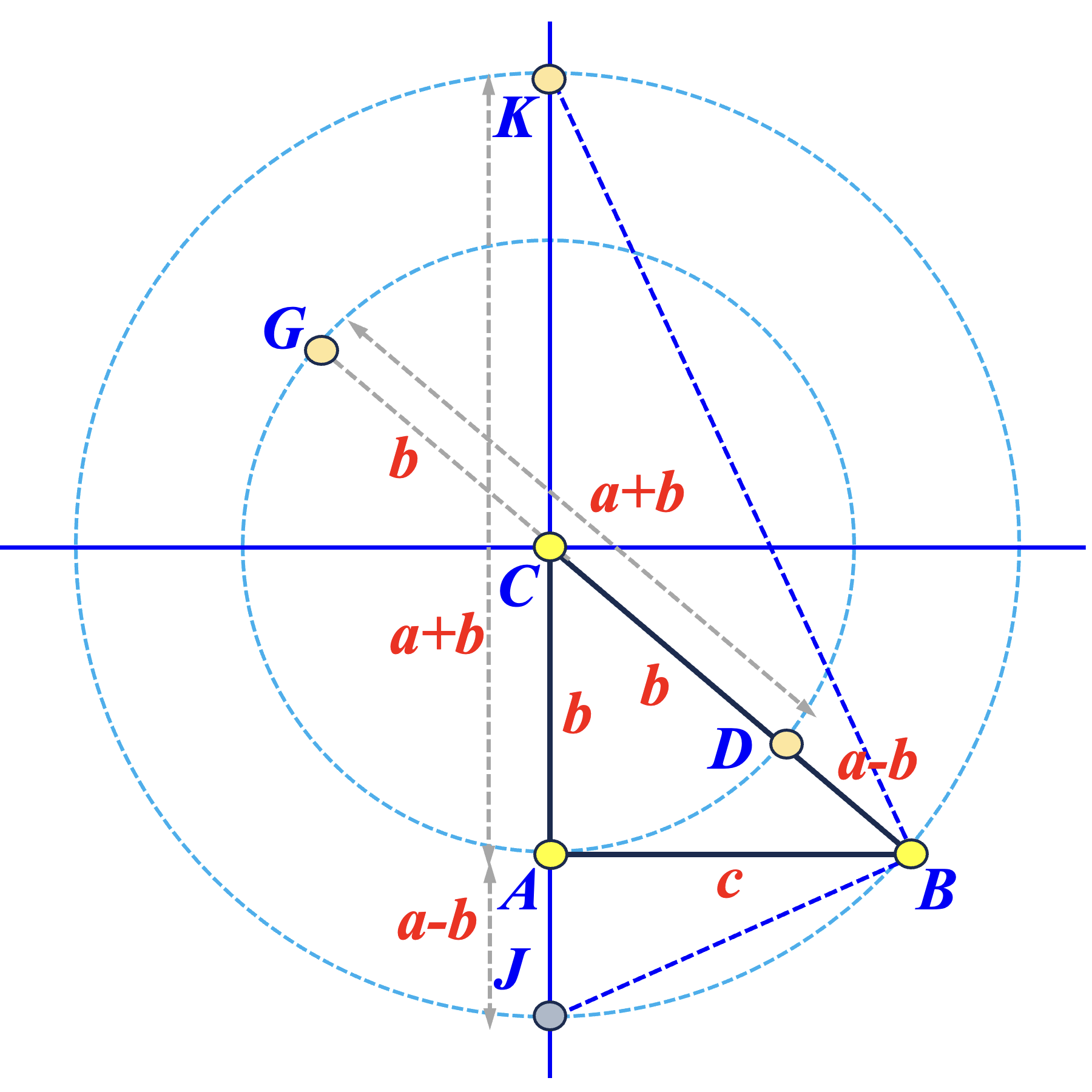
The circle of radius \( \overline{CB} = a \) and center \( C \) cuts the other side \( \overleftrightarrow{CA} \) at \( J \) and \( K \) and we have \( \overline{JA} = a-b \) and \(\overline{AK}=a+b \). Because \( \overline{JK} \) is a diameter of the circle, \( \bigtriangleup JBK \) is a right triangle with \( \angle JBK = 90^{\circ} \). As a result, we have \( \overline{JA}\cdot\overline{AK}=\overline{AB}^2 \), which is again \( (a-b)\cdot(a+b) = c^2 \), and hence \( a^2=b^2+c^2 \) holds.
This proof can be considered as a simplified form of Lengvárszky's Proof that uses the angle sum and angle different identities for the \( \tan() \) function.
Go back to Home Page.